Showing posts sorted by relevance for query uss iowa. Sort by date Show all posts

Tuesday, September 6, 2011

A New Mission For BB-61 USS Iowa


USS IOWA BB-61


Now Here This, Now Here This! A Special Announcement from the Secretary of the Navy.


LOS ANGELES, CA – The Secretary of the Navy (SECNAV) Ray Mabus announced today that the United States Navy has donated the Battleship USS Iowa to the Pacific Battleship Center, a Los Angeles‐based nonprofit on course to turn the ship into a permanent museum and memorial at the Port of Los Angeles.

The donation of the USS Iowa to the Pacific Battleship Center, under the Navy’s ship donation program, is the culmination of years of work by many dedicated volunteers. The USS Iowa is the only Iowa‐class battleship that has not been saved and turned into a permanent museum,and was the last battleship available for donation.

“We want to thank the Secretary of the Navy, and the entire United States Navy, for the donation of the USS Iowa to the Pacific Battleship Center,” stated Robert Kent, the President of the nonprofit. “With this award, the USS Iowa will become a permanent museum, memorial and educational center. We can now move forward with the work necessary to restore the ship and to bring her to the Port of Los Angeles.

”The Pacific Battleship Center acknowledged the support and thousands of hours volunteers have contributed to this project. “Without the support of our volunteers, the people of the Los Angeles area and the people of the State of Iowa, this dream would not have become a reality,”stated Kent.

While there are too many people to thank for this great achievement, we do want to make special mention of the efforts of Congressman Buck McKeon, Los Angeles Mayor, Antonio Villaraigosa, the Los Angeles City Council and their President, Eric Garcetti, the Los AngelesHarbor Commission and their President, Cindy Miscikowski, and Craig Nelson of Torrey‐PinesBank. This award also would not have happened without the tireless support of former Los Angeles City Councilwoman and current Congresswoman Janice Hahn. “Without the persistence of Congresswoman Hahn, the USS Iowa would not be coming to the Port of LosAngeles,” remarked Kent.

The people of Iowa were also instrumental in making this day a reality. We would like to thank Governor Terry Branstad and the Iowa Legislature for their support in appropriating $3 million this year for the restoration of the USS Iowa. The entire Iowa Congressional Delegation also supported the efforts to bring the USS Iowa to Los Angeles. Robert Kent commented, “I would like to particularly thank Congressman Tom Latham and Senator Charles Grassley, for their special efforts to help ensure that the USS Iowa becomes a permanent memorial for all of our citizens.”

As the Pacific Battleship Center moves forward with the restoration and relocation of the USS Iowa, there are still numerous opportunities to be part of this historic project. You may contact the USS Iowa’s new caretakers at
www.pacificbattleship.com.

I could not be more proud of the people of the non-profit organization Pacific Battleship Center who have worked so hard to make this a reality. Robert Kent and Trish Place, and hundreds of other volunteers have donated countless hours to bring this great ship back to life and deserve a huge amount credit and appreciation for a job well done. I have written before about the USS Iowa and the goal bring her to San Pedro where she will take on a new mission as a living history museum, and education center dedicated to the men and women who served in our armed forces and aboard great ships like the USS Iowa.

Wednesday, October 26, 2011

Anchors Away: The Iowa's New Mission Begins

A New Mission
Anchors Away

Silver star
Bronze star
Bronze star
Bronze star
Bronze star
Bronze star
Bronze star

Tomorrow at 1200 hours the lead ship of the great Iowa class battleships USS Iowa BB-61, will be gently eased from the anchorage she has occupied for the past ten years and moved to Pier 3 in Richmond, CA were she will undergo refirbishment to make ready for one final sea passage to her new duty station, at pier 87 in community of San Pedro, in the Port of Los Angeles. The following is the offical press release.
 USS IOWA to be towed to Richmond, Calif., beginning on Thursday
- Non-profit begins process to bring famed battleship back to life, transform vessel to interactive museum based in Los Angeles -
Los Angeles – October 25, 2011 – Pacific Battleship Center, the organization that is bringing the USS IOWA back to life, will begin towing the famed battleship from the Suisun Bay Reserve Fleet to Richmond, Calif., on Thursday, October 27, 2011.
In doing so, the non-profit group begins the months-long process to transform the vessel into an interactive experience permanently based at Berth 87 in Los Angeles. 
“This marks a significant milestone in our dedication to create the world's last available battleship for educational, historical and recreational benefits to those who visit her,” said Robert Kent, President of Pacific Battleship Center. “Our goal is to have the USS IOWA open for visitation by July 4, 2012. There is a great deal of work that needs to be performed starting with this towing evolution. We are excited to be launching into this next phase of restoring what is a true American treasure!”
The two-day event will start at approximately Noon on Thursday where USS IOWA will be towed from Suisun Bay to the Benicia Car Dock. The ship will remain there until 9 a.m. the following morning and make its way to Richmond Pier 3 on Friday. USS IOWA will stay in Richmond for approximately three months to complete refurbishment work before making the tow to Los Angeles.
Media is invited to cover the event at the various locations where the ship will pass along the entire transit. Interviews are available by phone and in person (if feasible) upon request.
In September, Secretary of the Navy Ray Mabus announced that the United States Navy donated the USS IOWA to the Pacific Battleship Center. The decision was possible under the Navy’s ship donation program and reflects the culmination of years of work by many dedicated volunteers. The USS IOWA is the only battleship of its class that has not been saved and turned into a permanent museum and was the last battleship available for donation.
“To meet our timeline for opening the ship to visitors, we -raised more than $10 million in donations and loans,” said Jonathan Williams, Vice President of Pacific Battleship Center. “We’ve been privileged to receive generous support from so many organizations to make this happen, including the State of Iowa, Torrey Pines Bank, the USS IOWA Veteran’s Association, and civic and business leaders. However, while ten million is the minimum amount needed more funds will allow even more development of the IOWA. We need others to get involved, including the general public and have launched a membership drive to entice those to join this worthwhile cause. We are excited about the initial response and support weare getting for this call out and anticipate keeping the momentum going!”
Interested people can follow the progress of bringing USS IOWA back to life on the organization’s website, Facebook and Twitter pages. Individuals can also sign up to become “plankowners” at Pacific Battleship Center
###© 2011 Pacific Battleship Center. All rights reserved.


Anyone who has followed this blog for the past year has been aware of my interest and support of this organization that is truly motivated by the spirit of volunteerism by scores of people who answered the call from Robert Kent, and the other dedicated people who formed the cadre of this organization and were able to raise millions of dollars, and encourage others, who to date have pledged over 85,000 hours to get her ready to open on July 4, 2012. I would encourage anyone living within driving range of San Pedro, and who wants to be a part of something worthwhile that will live on in time and stand as a living memorial to the history that the ship represents; to become a vollunteer by clicking on the pledge form. I know that my wife is already prepared to see me trudging out the door every weekend beginning in January, as I join the hundreds of others who have pledged to step up and make the "Big Stick" into the best living history museum and education center in the United States.

Sunday, June 10, 2012

This week, the "Transit of the USS Iowa", matched the "Transit of Venus", for a once in a lifetime event

USS Iowa's Transit to Home
Iowa, courtesy of Port of LA photo
This week saw two events take place that will only happen once in the lifetime of living humans. One, a celestial event where the planet Venus transited across the face of the Sun and except for the media sending images around the planet, would have passed unnoticed by most of humanity. The other great event, was visible. It was the transit of the USS Iowa, the last battleship to taste the open sea as she was moved down the main channel of the Port of Los Angeles to her permanent berth, where she will assume a new mission of being a living museum and education center, serving the people of Los Angeles and the millions of future citizens who will walk her decks to learn of the great naval heritage of America. Thousands lined the main channel, and millions more, were treated to viewing the transit on their evening news reports, as dozens of reporters, supported by a half score of helicopters hovering overhead, filming every meter of the Iowa's passage.

I cannot emphasis enough, the impact seeing this great ship come up the main channel meant for those of us who know the history of the United States Navy's birth from Six Frigates, to grow into the global force we field today. This force has matured with the nation, and today, is being called upon to resume their place as the prime strategic asset, as well as "A global force for good."  Ships like the Iowa, over their lifetime rarely fired their guns in anger, but as the ship's nickname "Big Stick" implies, allowed the United States to not only speak softly; but caused nations less inclined, to become silent, and listen to our message about guaranteeing freedom of the seas, and fair trade, as well as goodwill to all nations who have joined in a partnership that has seen the world move from countless millenniums of grinding poverty, to one where half the people on the planet have achieved middle class.

LA Maritime Museum

I was fortunate to view the passage from the fantail of the LA Maritime Museum's Angels Gate Tugboat where the complement reflected the diversity and interest of the community. As this  little group waited to watch the passage of the Iowa, the stories of why people turned out added to the tapestry of what the Iowa symbolized to those standing along the shore. One lady explained that she was there because her father had worked repairing Navy ships in the Bethlehem Steel shipyard in San Pedro for 40 years, only taking off two weeks in that entire time. Her father had passed, but she was their to pay tribute to the Iowa and honor her father's legacy. Hundreds of old sailors some barely able to walk, became silent, and stood at crisp attention and held their salutes as the ship's colors passed. One young man in the company of his parents, was decked out in a USS Iowa tee shirt and hat. His parents in casual conversation related how much their teenage son was interested in naval history and had actually toured the USS Missouri in Hawaii four times. My history professor genes kicked in, and we began to talk naval history, where upon this young man's knowledge was remarkable including knowing about Alfred Thayer Mahan, and how the two President Roosevelt's had been so instrumental in building the US Navy into a global force and ushering in our great power status. The young man's parents learning I was a great supporter of the Pacific Battleship Center wanted to know how their son could become involved as a volunteer. They were pleased to learn that the battleship would have both a education program as well as an overnight element to allow young people to experience the legacy of our maritime heritage.

Port of LA photo

Over the next few weeks as the Iowa prepares to open, hundreds of hands will be lent to put on the final touches before she opens July 7, 2012. I have noted it before, but cannot repeat it enough to publicly acknowledge a few people who brought the Iowa to life.

Trish Place and Robert Kent, PBC
Bryan Moss, USS Iowa veteran

This story began when Robert Kent as a young student, was in a library and book about battleships caught his eye. That chance encounter fostered a lifelong love affair with these great ships. Later, in the middle of a successful business career, Robert did what many do when they want to follow a dream. He changed careers, and founded an organization to help preserve these great ships.

The story of how the Iowa came to San Pedro, really started when a former Iowa crew member who had served on the Iowa during the Korean War, Bryan Moss, approached Robert, and proposed that the Pacific Battleship Center go after the Iowa and bring her to San Pedro. Over the next two years, Robert organized, planned, and promoted the idea to turn the Iowa into a dream he had nurtured for decades. That dream was to open a living ship museum  that would tell the story of these great ships in a way never before done. It is impossible to name the many people who supported Robert and the PBC, in this endeavour. But one stands out, his fiancee Trish Place has been the unsung hero who has been Robert's unwavering supporter, helper, and soon to be life partner.  In the beginning, Trish was the go-to person for all interest and questions, and today, symbolizes what loyalty and love can do. To Bryan, Robert and Trish, we who love this country, and the legacy that being a maritime nation has wrought; will be forever grateful for your intrepid pursuit of the dream to bring the Iowa to life.

UPDATE: Video of The transit of the USS Iowa courtesy of Joe Buscaino, LA City Councilman

Saturday, April 9, 2011

USS Iowa BB-61: Update

USS Iowa leading the fleet
USS Iowa training out her guns
USS Iowa in rough seas
Iowa coming home
Anyone who has visited or given this blog more than a casual glance will recognize I take a great interest in the United States Navy and especially their role in the Pacific during World War II. A few day ago I wrote about the possibility that Southern California will soon be the home port for the newest addition to a long list of navy museums that preserve and honor our naval heritage.
Scale model of USS Iowa at Pier 87
Model overview of pier 87
Today, I attended a special event at pier 87 in San Pedro , once home to the Battle Fleet before 1940 and major shipyards during World War II and after. The event was to gather support for a California Assembly Resolution to support awarding the battleship USS Iowa BB-61 to San Pedro, with a new mission of offering education programs in history, leadership, team-building, character development, and community service, as well as serving as a disaster control center. First and foremost, ship will assume a unique "Living Museum" role that will provide visitors with an "at sea" experience that will trace the Iowa's 50 year history.

Fire boat Warner L Lawrence
USS Iowa being moved
If all goes according to plan, the dog days of summer will see Los Angeles Fireboat Warner L Lawrence  leading a parade that welcomes the Iowa to her new home at Berth 87 . The support for this project has been astounding and includes former President George H. W. Bush , community, state, business and veterans organizations. As things move along and the final details are worked out this blog will keep you posted and give plenty of notice to invite all to come welcome this great lady to her new home.

In the coming years, as the memory of World War II and the Cold War fade with the passing of the greying veterans amongst us, this ship will live on; to offer a hallowed space for future generations to contemplate what it was like when men steeled their hearts, to sail such ships into teeth of fascism and totalitarianism.

Sunday, November 27, 2011

Fast Battleships: The Aegis System of World War II

USS Iowa plowing ahead on a new mission
Become a plank owner below

A month ago, I wrote about the New Mission for the USS Iowa BB-61 the lead ship of the last battleships build for the US Navy. Today, I wanted to revisit the Iowa and write a bit about the history of battleships in World War II, where their original mission to defeat the enemy fleet as decried by Alfred T. Mahan and his writings that had influenced naval doctrine since the turn of 20th century, was re-purposed to provide what we might dub the Aegis System of World War II.

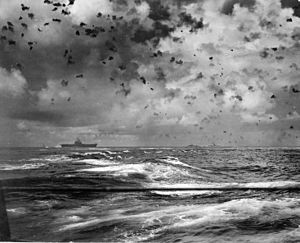
World War II saw the methods of sea control move from the barrel of  a 16" main gun battery to the air and under the sea. The battleships before the new classes of North Carolina and South Dakota could not keep up with the fast carriers, and consumed too much fuel to be deployed to support the early landings in the South Pacific. The newer classes arrived in the Pacific in October 1942, where they found a new mission of providing a massive platform for anti-aircraft guns to help fend off attacking planes that threatened the carriers. The Battle of Santa Cruz Islands, October 26, 1942 saw the effect of what the anti-aircraft firepower of the new battleships could do to protect a carrier. The American Order of Battle was divided into two groups; the USS Hornet, protected by two heavy cruisers, two anti-aircraft cruisers, and six destroyers, with a combined firepower of 72 5" DP guns and numerous 1.1 anti-aircraft mounts. The USS Enterprise group was protected by the USS South Dakota, one heavy, and one light cruiser and 8 destroyers with an equal battery of 1.1 anti-aircraft barrels and added 40 MM barrels on the South Dakota. The results of the battle saw the Hornet sunk, and the Enterprise damaged but surviving the onslaught of over 100 Japanese planes, with the South Dakota credited with shooting down 26 of the attacking planes by putting up 890 rounds of 5", 4,000 of 40MM, 3,000 1.1 and 52,000 rds. of 20MM.

South Dakota firing on Japanese bomber Oct 26, 1942

flak from South Dakota and San Juan
USS South Dakota Oct 26, 1942

I am not one to second guess history, but the concentration of having such a robust anti-aircraft gun platform as the South Dakota, supported by the antiaircraft cruiser USS San Juan CL-54 seemed to be the deciding factor in the Enterprise surviving to fight again. The effect of the lesser armed destroyers, in the Enterprise group was impacted when the USS Porter which carried no effective 5" guns, was accidentally torpedoed and required the assistance of another destroyer to rescue her crew in the height of the battle which potentially removed five 5" barrels from the fight. One can only surmise what would have happened it the Enterprise had been lost, or had there been no fast battleships ready to answer the call on the night of November 14-15, 1942.
As the war progressed, the six fast battleships were joined by the new Iowa Class ships, along with the their older sisters, re-floated, and re-armed with scores of anti-aircraft guns that produced such a volume of fire that when used with the new proximity fuse shells, saw no further losses of battleships or fast carriers, with only the light carrier USS Princeton being sunk during the battle of Leyte Gulf. In a time before guidance systems like the AEGIS, the battleship was the last line of air defense during the horrific final months of the Pacific War.


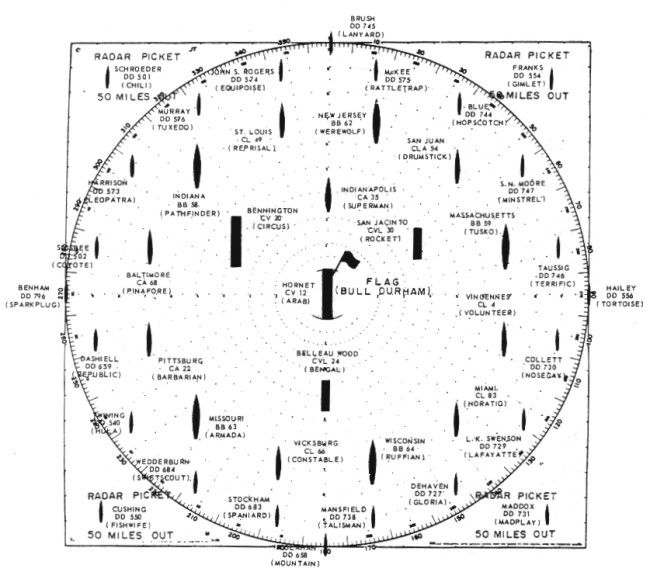
The Iowa class battleships brought 10 twin barrel 5" mounts, 20 Quad 40 MM mounts, and 49, 20 MM guns, which concentrated to put a wall of steel in front of any attacking foe, as the flag plot below showing five battleships surrounding four carriers will illustrate.

The effect of these great ships was also felt as they turned their main batteries to soften up every invasion beach after Guadalcanal which will be the subject of future post.

But for now, I want to pause to invite anyone reading this who has not already done so; to considering parting with a few dollars and becoming a Plank Owner on the USS Iowa as she prepares for a new mission of becoming the host of an education center and museum , devoted to preserving our naval heritage and the memory of those who served their country so valiantly. To those of you who live close to San Pedro, or in the bay area, where she currently needs volunteers to assist in painting and restoring her vast deck, I would invite you to fill out a volunteer pledge application and lend a hand in something you can tell your grandchildren about.


So in the immortal words of US Marine SGT Dan Daly,  lets see if we can all step it up and join the effort to make this the finest historical center on the world, devoted to our Naval heritage.

Sunday, June 3, 2012

Battleships: America's Symbol of Becoming a Great Power

USS Iowa, passing Golden Gate, 2012

History has recorded the rise of empires that spanned continents, but it took the rise of naval power to see influence and power expanded to global proportions. Nations in the past have tried, but did not have the source code of being a maritime nation to found and sustain a navy capable of being a global force. Not until Great Britain established a navy to be reckoned with in the 17th century, did a nation first become a global power. It was not until American naval officer Alfred Thayer Mahan wrote The Influence of Sea Power upon History: 1660-1783 in 1890, did nations begin to take measures to build strong blue water navies and saw Great Britain launch the for-runner of the modern battleship, the Dreadnought in 1906.

Roosevelt reviewing the fleet

The United States, in reality was a small nation that grew into what could best be described as a continental nation that had the geographic characteristics of an island, with two vast oceans on each side. Mahan's theory was adopted by then Assistant Secretary of the Navy Theodore Roosevelt, who moved to expand shipbuilding, and upon becoming President, launched the United States on the course that led to being a Great Power.

USS Iowa leading the battle line

The first, and most enduring symbol of the America's trajectory to becoming what Thomas PM Barnett wrote is, "The source code for this era's version of globalization, which superseded the colonial model of world integration after its collapse..." has been the battleship, which after four decades of being our symbol of naval force, saw the aircraft carrier and submarine, take the stage in projecting sea power and securing the sea lanes. However, battleships continued to serve alongside the carriers and add to the projection of force for the next five decades until the end of  the Cold War ushered in them into permanent retirement. Today, all of the surviving battleships stand as sentinels to the heritage that gave birth to a world that has seen more people achieve middle class status than anytime in history, and a world that has gone over half a century without a great power war.


Navy Seals visit Iowa at offshore

USS Decatur passes in review

This past week saw one of the last of these great battleships, the USS Iowa BB-61 taste the open sea one more time as she was moved south to the Port of Los Angeles to become a living history museum and education center. The passage of this great ship captured the attention of thousands who lined the shore as she passed under the Golden Gate. The active U.S. Navy stood in salute, and as she road at anchor having her hull cleaned off the coast of Los Angeles, Navy Seals and the USS Decatur cruised by to offer one more salute and pause to remember her service and the legacy of American naval sea power she represented.

Iowa coming into port
Iowa, doubling down

The interest in this great ship has continued; over 1200 have volunteered, to supplement the hundreds who worked the past seven months in Richmond, CA to make her ready to assume her new mission this July 7th, when she opens to the public. What makes battleships so special? Maybe it is because they are so powerful looking we stand in awe. Aircraft carriers look massive, but without air operations, seem benign and almost like visiting a floating city. Battleships on the other hand, bristle with all manner of fire power from their massive main guns, to the secondary weapons. American love their fireworks, and ships like the Iowa are a living symbol of the ultimate fireworks maker. Then there is the armor, as thick as 17" in some places, and inside the bowels, machinery that stand as a tribute to ingenuity and manufacturing skill of our forefathers. Those of you who read this on your computer might be surprised to learn that the first Mark I computers were designed and installed on the Iowa Class ships to calculate the firing solutions for their 16" guns.

The contributions of these great ships has been more than their intended role to slug it out with other battleships in great contests rivaling those that occurred two hundred years ago, as we remember the War of 1812. But it is well documented that without them, the history of our rise would not have been possible.