Showing posts with label uss Iowa. Show all posts

Sunday, November 11, 2012

In Reverse order: The Ugly, The Bad, and The Good, news of the week.

Iowa Vet "Mac" loving the flag and the ship
Photo Derek Cross
 
Petraeus, looking in the rear view mirror.

First the Ugly. The past couple of days have witnessed the downfall of someone whom most Americans admired and held in high esteem, General David Petraeus who tendered his resignation as CIA director, after it was discovered that he had an affair with a women, who in the course of collecting material for a biography, was almost inseparable during Petraeus's final months as the commander in Afghanistan. The curious thing about our changing attitude about indiscretions would probably have seen Eisenhower, Patton, and most certainly Admiral King and even President Roosevelt, removed from command during World War II, for the same weakness. One of the best pocket analogies of what might be going on, comes from fellow blogger Mark Safranski who hosts, zenpundit.com.

Mark sees both irony and a similarity in what he dubs a A Tale of Two Victories and Two Falls.
Ironically, one of the many Cabinet secretaries Nixon ignominiously fired in his bid to centralize power in his White House staff was his former 1968 primary rival, HUD Secretary George Romney, father of 2012 Republican nominee, Governor Mitt Romney. A blow from which George Romney’s political career never recovered. 
In looking at the Petrasus resignation on the eve of having to testify before Congress regarding the the Benghazi killings. Mark asks.
What however are the real issues? What should we be looking for?
Two things: As with Richard Nixon’s second term machinations, with such sweeping changes personnel changes in the offing for the Obama administration, ask yourself as events unfold: “Where is power flowing? And Why?”
If you do you will be in a better position to game out the direction of the next four years, especially in foreign policy and national security. 
Click on the link above, and take the time to ponder what Mark has written and check out the comments from Mr. X.

Badass US Marine signaling the enemy 
 Next we turn to the bad, as in "Badass". November 10th, marks the 237th birthday of the United States Marine Corps our preeminent "Badass" military branch. Two posts stand out. the first from Major General John A. Lejeune who penned this, on the 150th anniversary of  the corps.
The men recruited for this force were to be familiar life of the sea, but were to be trained as a military force, and was the intention to have them serve aboard the ships to be provided for the defense of the colonies. It is evident that the founders of the Marine Corps had in mind the fine services previously rendered by the British marines, both afloat and ashore, and that it was the intention to use the marines aboard the ships in naval battles when on the high seas and as landing forces when occasion might offer.
Read the whole article: November 10, 1775: The Birth of the Marine Corps

Chesty Puller and Dan Daly, outside legendary Tun Tavern
Photo duffelbag.com

And this, just in from the streets of Marine Corps Heaven:
THE STREETS OF HEAVEN – Trying to sit down for a quiet brew in Tun Tavern, the ghost of Dan Daly complained that once again the ghost of Chesty Puller “doesn’t know when to shut the fuck up.”
“We’re supposed to be guarding the streets up here, and I know our seventh general order is ‘talk to no one except in the line of duty,’” said Daly. “But there he goes, running his mouth to every new angel we get up here.”
Hi, I’m Chesty Puller. I won five Navy Crosses,” mimicked Daly in a girlish falsetto. “Shit, I’ve got one of those… right next to my TWO Medals of Honor.”
Like I wrote, "Badasses."
 Finally, the good. Today we pause to remember those who have served America and answered the call to arms. Most came home, and it is that day November 11th, that we honor  their service. This nation also pauses on Memorial Day, to remember those who gave their lives for the United States, but today is about those who also came home and regained their lives, many struggled and continue to try and heal in both mind and body the tribulations that comes with war. I was privileged to be aboard the USS Iowa this weekend where she was the backdrop for the City of Los Angeles first annual Veterans Appreciation Festival. The turnout was amazing, as veterans ranging from a few who served in the opening days of World War II, and continuing down the decades to active duty and even young ROTC cadets, lined up to walk the decks and be honored by the community and fellow citizens.
Iowa Veterans Appreciation Nov 10,2012
Photo Derek Cross
ROTC-San Pedro HS-and volunteer crew-USS Iowa
Photo:Derek Cross
 
Watching as men now in their eighties, some helped aboard by their proud families slowly made their way up the forward brow was an experience in humility as well as pride in our country. The moment they stepped aboard, their minds seemed to return to the period they served, and memories of so long ago. Many of these men will pass from our presence before the next Veterans Day, so it was especially important to make sure that every one of them was treated with the dignity and respect they had earned in their youth and carried forth over the generations to return one more time to a symbol of their youth and service. As my own Vietnam Generation edges closer to the winter days of our lives, making sure to honor those who preceeded us, know in their final days; that they were our "Greatest Generation."

Sunday, August 12, 2012

Let's always speak softly people, and carry a "Big Stick."

USS Iowa
Container ship unloading at Port of Los Angeles
Photo LA Times
The past few weeks the focus has been nautical as I have been writing about being a volunteer helping to restore the USS Iowa BB-61 from a state of suspended life, to a return to glory as a museum and education center. The ship is berthed along the main channel for the Port of Los Angeles where the guests and staff are treated to the daily arrival and departure of all manner of commercial vessels carrying the bulk of global commerce that fuels the rise of a global middle class. When a great container ship comes up the channel people gather on the port rails to gaze in amazement as these great ships make their way up the channel. For most of the people on the ship, this is the only opportunity to experience how connected the United States is to the rest of the world. Watching their reaction and having the opportunity to speak to many of them as they voice their new found awareness, led me to pen this post.
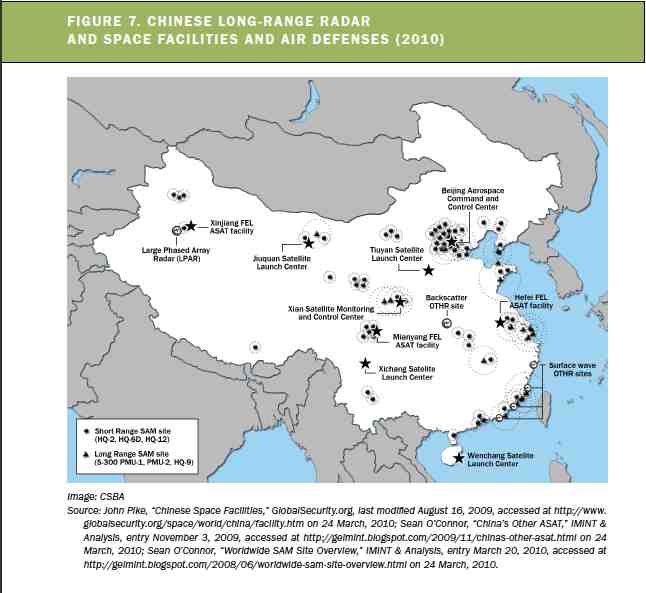
From the CSBA report on the ASBC: the section entitled "Blind PLA ISR Systems."
As our armed forces begin to find a way to extract ourselves from what has turned into a war of attrition in Afghanistan, the focus has turned to the sea and the discovery that our influence is adrift in many areas. Some voices are doing all they can to do what might be seen as "tagging" in a political sense by publicly releasing bombing targets to be sought in the opening rounds of a Sino/US conflict. Saner voices have begun to point out the inconsistency of our position as noted in this post from Thomas PM Barnett in Time's Battleland online, where Barnett pulls no punches in his criticism.
Nice Washington Post piece (by Greg Jaffe, of course) on the great COIN counterattack that is the Pentagon’s AirSea Battle.
As scenario work goes, what the Center for Strategic and Budgetary Analysis has done in its war-games has to rank right up there with the most egregiously implausible efforts ever made to justify arms build-ups.
Read more: AirSea Battle: The Military-Industrial Complex’s Self-Serving Fantasy

On the Beach (1959)

Barnett was just getting wound up in his desconstruction of this concept and continued write more on the topic, by commenting and linking an analysis by an Australian strategist who if we recall the film On the Beach  is about the last place standing after a bunch of great powers pulled the ultimate trigger.
AirSea Battle calls for deep strikes on the Chinese mainland to blind and suppress PLA surveillance systems and degrade its long-range strike capabilities. Such an attack, even if it relied solely on conventional systems, could easily be misconstrued in Beijing as an attempt at pre-emptively destroying China’s retaliatory nuclear options. Under intense pressure, it would be hard to limit a dramatic escalation of such a conflict – including, in the worst case, up to and beyond the nuclear threshold.
 Barnett adds his own comments and literally calls out loudly the reality of pulling the trigger in a hope of preserving US hegemony.
Keeping China from doing something truly stupid in East Asia is not hard. We need to undermine their asymmetrical approach by - as this article argue - creating our own, and NOT by setting ourselves up for a rapidly escalating great-power war. Bombing the length and breadth of China in the opening hours of some crisis is just plain stupid and reckless and painfully unimaginative. This is a massive retaliation response that pretends China isn't a nuclear power capable of significant retaliation.
Sometimes I feel like I'm the only person who hasn't taken the crazy pill on this one: YOU DON'T CONDUCT WIDESPREAD BOMBING CAMPAIGNS AGAINST THE HOMELANDS OF NUCLEAR POWERS!
Why is Thomas Barnett right on this isssue? It is written in his next post, which goes hand in hand with those container ships that slide past the USS Iowa on a daily basis.
Point being, we are locked in a symbiotic relationship with China. There is no good global economy without us and there is no good global economy without them.
 This is what gets me when Pentagon strategists casually consider war with China, to include direct attacks on the Chinese homeland. What happens to the global economy when the two intertwinned biggest national economies decide to start blowing each other's citizens up? The global economy would tank at a speed that would stun everybody. There wouldn't be any days or weeks of bombing campaigns. We'd have global economic turmoil of a stunning nature well before that, as the markets would freak out.
And this final spot-on broadside from Barnett's keyboard.
Beyond that fantastic scenario extension lies CSBA’s plans to basically destroy the entire Chinese air force and submarine fleet, plus institute a “distant blockade” that would see us interdict and search—and here the irony balloons—China’s seaborne trade, which ought to be fairly simple since so much of it involves the US economy. And because it’s not easy to stop committed large ships (don’t tell Somalia’s pirates), CSBA broaches the notion of using Air Force bombers to “provide ‘on-call’ maritime strike.” One can only imagine how many thousands of Wal-Mart containers the US military could send to the bottom of the Pacific before the White House would hear some complaints from the US business community. But why let that reality intrude?

Read more: A complication that displays the interdependency between the Chinese and US economies

Now I am a realist, as well as being a bit of a hawk in the area of defense, but Barnett makes sense on this one.

The interest of the United States strategically remains and has always been to preserve our interests as a maritime nation and having not only a strong navy, but a solid strategy is the bedrock principal in continuing to lead that role. It seems that other's are sensing the same thing. Several new blogs have appeared in the past couple of months to join the bevy of excellent sites like Information Dissemination, and US Naval Institute Blog. Two of the most active are the Center for International Maritime Security and most recently, The Diplomat's Flashpoint.  Naval centric topics have joined the list of simulations on Wikistrat "When China’s Carrier Group Enters the Persian Gulf".

My advice is for everyone to keep their powder dry and their nukes locked shut and take the time to ponder how we can all share this blue, as in mostly covered in water planet in peace. Being prepared is essential to a nation's survival, but bluster, and veiled threats of insured destruction, are about as productive as announcing that your planning to negotiate a new loan, while seated across from the banker, fully armed and wearing combat gear and twirling your pistol. In the best traditions of our country, we have always managed our way through over a century of being a great power by following Theodore Roosevelt's admonition to "Speak softly, and carry a big Stick." It is not lost that the USS Iowa's nickname is "Big Stick."


Sunday, July 8, 2012

A Love Affair

Iowa #1 turret

I have a confession to make. I have fallen in love, deeply and overjoyed every time I am with her. I can't wait to rush down to visit her and crawl all over her magnificent frame and marvel at her every nook and cranny. I am speaking about my love affair with the USS Iowa BB-61 now open as a museum and education center at pier 87, in San Pedro, CA.

Robert Kent, CEO Pacific Battleship Center

The affair began from afar, when I first became acquainted with the efforts of the Pacific Battleship Center led by Robert Kent and company, to bring the Iowa to Southern California. However, I was not prepared for what happened a few weeks ago when I first stepped aboard her wooden decks and took my place alongside dozens of fellow volunteers willing to give up days off, to grind, weld, scrape, paint, replace decks, and haul all manner of material, in an effort to get her dressed for her grand opening. I wrote in a previous post about those first days and the intrepid crew that led the volunteers who make up the ship operations division. The story that unfolded since that first post, has become more than a brief footnote in this great ships lifetime, but an ongoing journey that sees men and women falling in love with  this ship and her history.

Last week, my brother, Vince, navy veteran, and former caretaker on the USS Hornet, came down for our annual visit, and being a fellow plank owner on the Iowa, joined me in bringing her to life. Our motivation was in part to honor the memory of our father, Jay Wade, Navy veteran of World War II, who served in the Pacific throughout the war. We left the house before dawn last Friday, and queued up on the dock to be checked by the diligent security team before bounding up the gangway. We then proceeded to a berthing space/wardrobe division, where we changed to blue coveralls, and then mustered in crews mess for our safety meeting and job assignments. Our fellow crew members ranged from young high school ROTC members, veterans, retired shipyard workers, and some who never served, but soon became shipmates, as devoted as any assembled in our country's history. After getting our assignments we dispersed in small groups where within a few minutes, informal leadership was established, along with the kind of bonding that can only occur when people do jobs that involve some level danger and skill.

Removing armored hatch, Wade brothers on the cheater bar. Mike Getscher on the torch
"Man against steel, man always wins." Mike Getscher, Chief Engineer, USS Iowa, 2012

As the day progressed, the bonding became as natural as mixing sugar and cream in coffee, until the perfect blend of teamwork led to a job being completed on time, and without injury. The common thread that surfaced in working with everyone in what is know as "Ship Ops" is the joy that kept everyone hard at work as sweat stained our caps and coveralls, and empty water bottles began to be strewn about like shell casings during a "Kamikaze" attack in 1945. Being a historian and an observer of people, the breaks between assignments gave me an opportunity to learn about my fellow volunteers, and what led them to work for the sum of hard work and toil. To a man and women, they all confessed it happened after the first day they stepped aboard. Many came with the idea of working a day or two as a way to see the ship. However, for all I spoke too, seduction stepped in, as the Iowa, being the grand lady she is, caused all who grace her decks and hallowed passageways, to fall in love with her magnificent body, and the spirit one can physically sense in every compartment.

Over the next four days, Vince and I, joined with our new brothers and a few sisters, to make the ship ready not for sea; but to receive hundreds of former Iowa crew members, and for the grand opening on July 7. As the countdown continued, deadlines had to be met, welding teams worked 24/7 to prepare the new brows, and our teams scrambled to hang fire extinguishers, rig emergency lighting, repair rails and ladders, and clear the deck, so as to pass the important fire inspections for safety and security.

Daily Breeze Photo: Robert Casillas

Monday afternoon July 2nd, saw the ship welcome the hundreds who had become "Plank Owners" by contributing money to fund the ship's restoration. They were joined by many veterans of the Iowa who were holding their reunion over the next few days. Those veterans showed that the love for the ship does not dissipate with time, but only grows deeper, and more moving. Old men stepped aboard, and within the blink of an eye, they became 20 again, as they returned to what for most, was the most memorable time in their lives. One fellow volunteer related taking a veteran who had been assigned to the engine room, down several decks, steadying his feet each step, as the veteran's caregiver held his arms. My fellow shipmate related that tears welled up in that old veteran's eyes when he entered the space where he entered adulthood so long ago, and for a moment, he shed scores of years as he told about working in the heat of the South Pacific so long ago. Similar images played out hundreds of times around the ship, as men showed their wives, children, and grand children where grandpa had lived and fought for his country.

For this old army veteran, it brought tears to my eyes as one realized that these men in the very twilight of their lives, sought for one more time to visit the woman who still held their first love. We who are volunteers have come to know the same feeling that inspired those men. I can not fully explain it, but here I am today making a public confession that I love that ship and cherish every moment I step aboard her historic decks.
Dedication ceremony July 4, 2012

This story is continuing to unfold. When the ship opened this Saturday July 7th, over 4000 people lined up to walk her decks and marvel at the power projected in her massive 16" guns. There is much more work to be done to open more of the ship to the public. Volunteers are welcome, but beware that this lady will seduce you, and steal your heart forever. I can not say enough about the leadership of this organization, our skipper Robert Kent, and his staff. Special recognition must be given to our own Lt. Dan, who as assistant ships engineer was the ramrod and spark plug behind our daily efforts. Dan, is a dynamo, who along with Mac our CPO, used the forum of our safety meetings to remind us all in a sonnet, that this ship was a lady who deserved respect, and would treat you right if you treated her right, and hurt you if you forgot to respect her and treat her like gold. Then there is volunteer, Jim Baca who was joined by his wife Sandra, and son. Jim alone, has volunteered over 700 hours the past nine months as the ships electrician/gunners mate, and is a wealth of information on the 16" guns. His wife a former navy veteran herself, remarked that they when they found the Iowa, volunteering was a natural as when they both first joined the Navy.

There are many others behind the scene, each of whom played an integral part in bring the Iowa to life. Some I came to know, like Robert's daughter Erin, who runs the wardrobe department, and always has a kind word for all who came to help. Then there is exhibit curator Dave Way, who worked tirelessly, to take a cluttered space, clean it up, and create a informative museum that showcases the history of the Iowa, and the heritage of battleships, while interviewing tour guide candidates, and planning for future exhibits. And finally, perhaps the hardest working of all, volunteer coordinator Sue Schmidt, who often was sending email up dates, (well after the bars had closed,) just to give you an idea of the time frame of her work day, as she coordinated the thousands of volunteer applications and scheduling assignments.

gunnersmate/electrician Jim Baca
Lt Dan and wife Vicky
Dave Way
Sue Schmidt

I wake every morning, longing for the chance to become a permanent member of her crew as the museum and education center become active. Until then, I will keep volunteering, and spending as much time as possible enjoying what for me, is both a time machine, a primary source for history to our country's maritime heritage, and now; one of the great loves of my life.

Yours truly, HG
Volunteer link
Virtual Tour of Iowa, LA Times

Wednesday, June 20, 2012

USS Iowa: Progress Report

Iowa in San Pedro
Volunteers on Iowa

Today I was privileged to spend the day on board the USS Iowa with dozens of motivated volunteers and a small dedicated staff who are literally working their tails off getting Iowa ready for the celebrations the will begin July 2, and continue as she hosts the USS Iowa Veterans Reunion and then her grand opening on July 7. The work already done in Richmond produced amazing results for a ship that was left absorbing the elements for over twenty years. Much work is still needed to get her ready, and what amounts to enough volunteers to almost fill her original complement, have stepped forward in such numbers to keep the scheduling staff working day and night, processing the applications of those willing to lend a hand.

This was my second day aboard the Iowa. Last weekend I joined up with a small group of strangers who soon became shipmates, as we went about the task of removing the walls of a petty officers lounge to make way for expanding the museum space. The task at first seemed daunting as the walls resisted our grinding tools that made little progress against what turned out the be honeycomb metal walls. We soon collectivly seized upon using a combination of metal saws and grinders to cut away the walls and open the space. Sparks flew, smoke spewed, and the ever present danger of fire, was suppressed under a careful watch. The walls soon gave way to present a new problem of how to get them topside. All the while, our little group continued to bond and in doing so, put our heads together to solve the problem of removing walls, then winching them topside through the hatch via a block and tackle. By the end of the day we were the tightest of shipmates, and left for our homes with a feeling of accomplishment, and even deeper, that sense of comraderie when you've made new friends.
Lt. Dan, Operations Boss
Today was no different, as the volunteers gathered in a crew dining space and awaited the safety meeting which is the daily benediction, before fanning out to the various assignments. Except for staff, most of the faces were new to me; except James a fellow volunteer from our Saturday crew. He and I were assigned to go with the Ship Ops Lead, Mac, to  raise the colors on the fantail, and them forward to raise the pennant on the bow. We then collected a half dozen ROTC students from San Pedro High, who had been coming aboard every day this week to lend a hand. The main task today was to move a large stack of life rafts racks to the side of the ship for removal to the dock. They were nested in rows below the barrels of number three turret and needed to be moved to the side of the ship where they would be hooked on to the forks of a lift and off loaded onto the dock. I must admit, it was challenging work, as we carefully untied the racks, stacked four high, and then by shear muscle power lifted then to the deck, and carried them to the rail, careful not to mar the wooden deck.
"Mac"
Our leader, was a former Iowa crew member who we will acknowledge as "Mac" who's first priority was doing it Safely, Safely, and more Safely!. The students worked along side old salts, and this old army guy, as we moved those heavy racks one by one to the side for offloading. Mac, kept everyone's head in the game with his ever present cautioning and if needed chewing out if anyone strayed from paying attention to the lurking danger associated with offloading such material. He demonstrated, then supervised the careful hooking of the straps, and calling out caution as each rack soared over the side onto the dock.  We them moved onto other assignments, each acomplished without a whimper of complaint, or any shirking to the task by old or young. The ROTC group consisted of five boys and one girl, who represented the diversity of Los Angeles and America today. Our next task was moving 60 cases of water, by forming a chain gang and passing the cases across the deck to a hatch where they were slid them down to the galley below and via chain gang moved snake like to a storage space. Again, us old guys were hard pressed to keep up with the enthusiasm of those students. During a break I learned that they were part of an Air Force ROTC program, and all planned to go into the Air Force, (too bad Navy, as they would make great sailors). All I can say is I tried to pitch them to consider switching services when they graduated.

I came away with two impressions, the first, that all of those who have volunteered, each feel a deep sense of commitment to the ship and the sea service. And second, they all share the feeling that they are part of a great enterprise, and take immense pride in working on the Iowa. Even more heartening, was my impression of the high school students who never once complained, or shirked from any assignment, and actually jumped at any task they were assigned. I am assured, that some of America's future leaders were among that group, and demonstrated the kind of grit and innovation that is a purely American trait.

Sunday, June 10, 2012

This week, the "Transit of the USS Iowa", matched the "Transit of Venus", for a once in a lifetime event

USS Iowa's Transit to Home
Iowa, courtesy of Port of LA photo
This week saw two events take place that will only happen once in the lifetime of living humans. One, a celestial event where the planet Venus transited across the face of the Sun and except for the media sending images around the planet, would have passed unnoticed by most of humanity. The other great event, was visible. It was the transit of the USS Iowa, the last battleship to taste the open sea as she was moved down the main channel of the Port of Los Angeles to her permanent berth, where she will assume a new mission of being a living museum and education center, serving the people of Los Angeles and the millions of future citizens who will walk her decks to learn of the great naval heritage of America. Thousands lined the main channel, and millions more, were treated to viewing the transit on their evening news reports, as dozens of reporters, supported by a half score of helicopters hovering overhead, filming every meter of the Iowa's passage.

I cannot emphasis enough, the impact seeing this great ship come up the main channel meant for those of us who know the history of the United States Navy's birth from Six Frigates, to grow into the global force we field today. This force has matured with the nation, and today, is being called upon to resume their place as the prime strategic asset, as well as "A global force for good."  Ships like the Iowa, over their lifetime rarely fired their guns in anger, but as the ship's nickname "Big Stick" implies, allowed the United States to not only speak softly; but caused nations less inclined, to become silent, and listen to our message about guaranteeing freedom of the seas, and fair trade, as well as goodwill to all nations who have joined in a partnership that has seen the world move from countless millenniums of grinding poverty, to one where half the people on the planet have achieved middle class.

LA Maritime Museum

I was fortunate to view the passage from the fantail of the LA Maritime Museum's Angels Gate Tugboat where the complement reflected the diversity and interest of the community. As this  little group waited to watch the passage of the Iowa, the stories of why people turned out added to the tapestry of what the Iowa symbolized to those standing along the shore. One lady explained that she was there because her father had worked repairing Navy ships in the Bethlehem Steel shipyard in San Pedro for 40 years, only taking off two weeks in that entire time. Her father had passed, but she was their to pay tribute to the Iowa and honor her father's legacy. Hundreds of old sailors some barely able to walk, became silent, and stood at crisp attention and held their salutes as the ship's colors passed. One young man in the company of his parents, was decked out in a USS Iowa tee shirt and hat. His parents in casual conversation related how much their teenage son was interested in naval history and had actually toured the USS Missouri in Hawaii four times. My history professor genes kicked in, and we began to talk naval history, where upon this young man's knowledge was remarkable including knowing about Alfred Thayer Mahan, and how the two President Roosevelt's had been so instrumental in building the US Navy into a global force and ushering in our great power status. The young man's parents learning I was a great supporter of the Pacific Battleship Center wanted to know how their son could become involved as a volunteer. They were pleased to learn that the battleship would have both a education program as well as an overnight element to allow young people to experience the legacy of our maritime heritage.

Port of LA photo

Over the next few weeks as the Iowa prepares to open, hundreds of hands will be lent to put on the final touches before she opens July 7, 2012. I have noted it before, but cannot repeat it enough to publicly acknowledge a few people who brought the Iowa to life.

Trish Place and Robert Kent, PBC
Bryan Moss, USS Iowa veteran

This story began when Robert Kent as a young student, was in a library and book about battleships caught his eye. That chance encounter fostered a lifelong love affair with these great ships. Later, in the middle of a successful business career, Robert did what many do when they want to follow a dream. He changed careers, and founded an organization to help preserve these great ships.

The story of how the Iowa came to San Pedro, really started when a former Iowa crew member who had served on the Iowa during the Korean War, Bryan Moss, approached Robert, and proposed that the Pacific Battleship Center go after the Iowa and bring her to San Pedro. Over the next two years, Robert organized, planned, and promoted the idea to turn the Iowa into a dream he had nurtured for decades. That dream was to open a living ship museum  that would tell the story of these great ships in a way never before done. It is impossible to name the many people who supported Robert and the PBC, in this endeavour. But one stands out, his fiancee Trish Place has been the unsung hero who has been Robert's unwavering supporter, helper, and soon to be life partner.  In the beginning, Trish was the go-to person for all interest and questions, and today, symbolizes what loyalty and love can do. To Bryan, Robert and Trish, we who love this country, and the legacy that being a maritime nation has wrought; will be forever grateful for your intrepid pursuit of the dream to bring the Iowa to life.

UPDATE: Video of The transit of the USS Iowa courtesy of Joe Buscaino, LA City Councilman

Sunday, June 3, 2012

Battleships: America's Symbol of Becoming a Great Power

USS Iowa, passing Golden Gate, 2012

History has recorded the rise of empires that spanned continents, but it took the rise of naval power to see influence and power expanded to global proportions. Nations in the past have tried, but did not have the source code of being a maritime nation to found and sustain a navy capable of being a global force. Not until Great Britain established a navy to be reckoned with in the 17th century, did a nation first become a global power. It was not until American naval officer Alfred Thayer Mahan wrote The Influence of Sea Power upon History: 1660-1783 in 1890, did nations begin to take measures to build strong blue water navies and saw Great Britain launch the for-runner of the modern battleship, the Dreadnought in 1906.

Roosevelt reviewing the fleet

The United States, in reality was a small nation that grew into what could best be described as a continental nation that had the geographic characteristics of an island, with two vast oceans on each side. Mahan's theory was adopted by then Assistant Secretary of the Navy Theodore Roosevelt, who moved to expand shipbuilding, and upon becoming President, launched the United States on the course that led to being a Great Power.

USS Iowa leading the battle line

The first, and most enduring symbol of the America's trajectory to becoming what Thomas PM Barnett wrote is, "The source code for this era's version of globalization, which superseded the colonial model of world integration after its collapse..." has been the battleship, which after four decades of being our symbol of naval force, saw the aircraft carrier and submarine, take the stage in projecting sea power and securing the sea lanes. However, battleships continued to serve alongside the carriers and add to the projection of force for the next five decades until the end of  the Cold War ushered in them into permanent retirement. Today, all of the surviving battleships stand as sentinels to the heritage that gave birth to a world that has seen more people achieve middle class status than anytime in history, and a world that has gone over half a century without a great power war.


Navy Seals visit Iowa at offshore

USS Decatur passes in review

This past week saw one of the last of these great battleships, the USS Iowa BB-61 taste the open sea one more time as she was moved south to the Port of Los Angeles to become a living history museum and education center. The passage of this great ship captured the attention of thousands who lined the shore as she passed under the Golden Gate. The active U.S. Navy stood in salute, and as she road at anchor having her hull cleaned off the coast of Los Angeles, Navy Seals and the USS Decatur cruised by to offer one more salute and pause to remember her service and the legacy of American naval sea power she represented.

Iowa coming into port
Iowa, doubling down

The interest in this great ship has continued; over 1200 have volunteered, to supplement the hundreds who worked the past seven months in Richmond, CA to make her ready to assume her new mission this July 7th, when she opens to the public. What makes battleships so special? Maybe it is because they are so powerful looking we stand in awe. Aircraft carriers look massive, but without air operations, seem benign and almost like visiting a floating city. Battleships on the other hand, bristle with all manner of fire power from their massive main guns, to the secondary weapons. American love their fireworks, and ships like the Iowa are a living symbol of the ultimate fireworks maker. Then there is the armor, as thick as 17" in some places, and inside the bowels, machinery that stand as a tribute to ingenuity and manufacturing skill of our forefathers. Those of you who read this on your computer might be surprised to learn that the first Mark I computers were designed and installed on the Iowa Class ships to calculate the firing solutions for their 16" guns.

The contributions of these great ships has been more than their intended role to slug it out with other battleships in great contests rivaling those that occurred two hundred years ago, as we remember the War of 1812. But it is well documented that without them, the history of our rise would not have been possible.

Wednesday, May 16, 2012

Sailing Orders: USS Iowa BB-61


USS Iowa, by Don Bartletti, LA Times

From Los Angeles Times May 12, 2012


In four days May 20, 2012, a trio of tug boats will begin to ease the USS Iowa away from the pier in Richmond, CA where she has undergone an extensive re-refurbishment that resembled her past preparations for a deployment. However, in this case, instead of off to war, she is being prepared to sail one more time as she is moved south to be anchored off the Port of Los Angeles and given a final touch up before being the main event in a grand entrance down the main channel to berth 87 in San Pedro, former home of the US Navy's Battle Fleet from 1919-1940. This great undertaking is led by the Pacific Battleship Center headed by Robert Kent, and a devoted staff, along with hundreds of volunteers who have been working long hours in Richmond, as well as many hundreds more waiting in Southern California, who are anxious to climb aboard and help get her sparkling, and ready to become what is destined to be the finest living ship museum, and education center in the world.


I have watched the progress as the ship left Suisun Bay last October and was moved to pier 3 in Richmond, and as each week passed, followed the updates posted by many of those volunteers on the Facebook page for Pacific Battleship. This weekend will mark a new chapter for the Iowa and a chance to taste the tang of the open seas as she passes the near littorals and moves south to her new home. A web page has been set up to track her progress as she is towed by Crowley tug Warrior and her cohorts. Soon, I will be taking my turn in preparing her for July 7th, when her gangway will welcome thousands who have a hankering to experience the aura of this grand ship and learn of her sailors and missions that spanned over half a century.

This week also is the final opportunity to become a plank owner, so anyone who wants to both pitch in or lend a hand, visit the link below.

Plank Owners

volunteer


Saturday, February 11, 2012

Back on the Bridge, and Forging Ahead!

Forging on ahead!

Wikistrat North American Energy Export Boom


The blog has been a bit quiet this past week as I started teaching a new round of classes, and contributing to two simulations for Wikistrat, What Comes After Chavez? and, an in-depth project, the North American Energy Export Boom. Both simulations are excellent, and the cloud of minds that have been assembled, have led to insights beyond my expectations. Mindful of neglecting the blog, I want to step back onto the bridge, and into the realm of history, and visit my favorite subject, naval history and how it relates to this nation's heritage and future security.

USS Iowa BB-61
tour route of Iowa

A couple of weeks ago, I attended a presentation by Robert Kent, President and founder of the Pacific Battleship Center, now tasked with preserving the USS Iowa BB-61 the Battleship of Presidents as a living museum and education center, soon to be stationed at Pier 87 in San Pedro, California. I wrote stationed, because unlike other museum ships, the Iowa along with her sister the Wisconsin, is mandated by Congress to be kept in a state or readiness, so if the need arises, they can be returned to duty to defend the nation.

Robert Kent, CEO, Pacific Battleship Center

What Robert Kent conveyed to those gathered was a view into how the Iowa will be preserved, and how it will convey not only the history of it's long service, but the history of the great gun ships down through history. More than just examples of firepower will be displayed, visitors will learn about the level of engineering skill that went into designing, and building the massive turrets with a precision that compared to the best Swiss watches. As visitors move deeper into the center of the great ship, they will experience what it was like to live and work aboard the ship, from her commissioning on Washington's Birthday, 1943, to the last time her ensign was lowered in 1990.
.
The Iowa is a living example of the industrial ingenuity and the skill of the thousands of workers who fashioned the machinery that even today stands as an engineering marvel. Using the latest technology, visitors will be able to experience via the magic developed in Hollywood, a "Life at Sea." as they are taken on tours, guided by experts who will give them the experience of being on a active duty ship. Without giving away any trade secrets the tours will set the bar for museum experiences, to a new level. I can not say enough about this amazing enterprise.  After meeting Robert and his indispensable partner Trish Place, I was impressed enough to be willing to swab the deck, chip paint, and any other task, just to share in their passion for this great ship. They have led this effort with all the skill of the greatest naval captains who ever commanded a ship and deserve a fleet wide signal of Bravo Zulu.


As noted above, the battleship is to be maintained in a state of readiness in the event of having to be recalled to duty. Recent developments in armaments have been touted as making gun ships completely obsolete, where million dollar a shot cruise missiles, drones, and the soon to be deployed, railgun which if all goes well, will be on navy ships within five years. But wait! is it wise to shed the tried and true methods of defense? One of the advantages of the Iowa is that she is equipped with both guns, cruise missiles, and anti-ship missiles. There is a soon to be released fiction movie based on the board game "Battleship," where a modern naval fleet when confronted with an alien invasion must fall back to the old reliable and obsolete battleship to save planet Earth. I know this is great fiction, but recent developments in a weapons system that will defeat electronics, including radar, computers, and the control of missiles, was successfully tested by the Air Force in May, 2011. This technology uses HPM (high power microwave), which is the non-nuclear equivalent of the EMP (electromagnetic pulse) weapon. It stands to reason that what we have now, will soon be had by other nations, (think nukes). So given that reality, it's back to the future for war-fighting.

A final thought about the battleship and her main armament the 16 inch gun, and it's amazing accuracy, along with the relative cost per round, compared to the cost of a cruise missile, is something to ponder when considering the cost of launching hundreds of cruise missiles into Libya last year. A few weeks ago, I attended the West 2012 Conference about the Navy in the 21st century, and listened, as both the Navy and Marines discussed the need to maintain the ability to preform a forced entry by sea, something that hearkens back to the days of Alexander the Great. Hopefully, that day never comes, but until the railgun, or some other technological advancement is developed to defeat HPM weapons, the last two Iowa class battleships stand ready to answer the call.

For those who would like to be a plank owner, the window is still open for a couple more months.
USS Iowa Plank owner

Sunday, November 27, 2011

Fast Battleships: The Aegis System of World War II

USS Iowa plowing ahead on a new mission
Become a plank owner below

A month ago, I wrote about the New Mission for the USS Iowa BB-61 the lead ship of the last battleships build for the US Navy. Today, I wanted to revisit the Iowa and write a bit about the history of battleships in World War II, where their original mission to defeat the enemy fleet as decried by Alfred T. Mahan and his writings that had influenced naval doctrine since the turn of 20th century, was re-purposed to provide what we might dub the Aegis System of World War II.

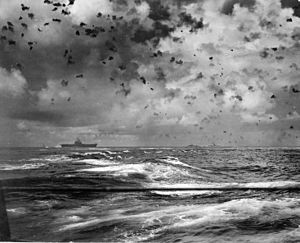
World War II saw the methods of sea control move from the barrel of  a 16" main gun battery to the air and under the sea. The battleships before the new classes of North Carolina and South Dakota could not keep up with the fast carriers, and consumed too much fuel to be deployed to support the early landings in the South Pacific. The newer classes arrived in the Pacific in October 1942, where they found a new mission of providing a massive platform for anti-aircraft guns to help fend off attacking planes that threatened the carriers. The Battle of Santa Cruz Islands, October 26, 1942 saw the effect of what the anti-aircraft firepower of the new battleships could do to protect a carrier. The American Order of Battle was divided into two groups; the USS Hornet, protected by two heavy cruisers, two anti-aircraft cruisers, and six destroyers, with a combined firepower of 72 5" DP guns and numerous 1.1 anti-aircraft mounts. The USS Enterprise group was protected by the USS South Dakota, one heavy, and one light cruiser and 8 destroyers with an equal battery of 1.1 anti-aircraft barrels and added 40 MM barrels on the South Dakota. The results of the battle saw the Hornet sunk, and the Enterprise damaged but surviving the onslaught of over 100 Japanese planes, with the South Dakota credited with shooting down 26 of the attacking planes by putting up 890 rounds of 5", 4,000 of 40MM, 3,000 1.1 and 52,000 rds. of 20MM.

South Dakota firing on Japanese bomber Oct 26, 1942

flak from South Dakota and San Juan
USS South Dakota Oct 26, 1942

I am not one to second guess history, but the concentration of having such a robust anti-aircraft gun platform as the South Dakota, supported by the antiaircraft cruiser USS San Juan CL-54 seemed to be the deciding factor in the Enterprise surviving to fight again. The effect of the lesser armed destroyers, in the Enterprise group was impacted when the USS Porter which carried no effective 5" guns, was accidentally torpedoed and required the assistance of another destroyer to rescue her crew in the height of the battle which potentially removed five 5" barrels from the fight. One can only surmise what would have happened it the Enterprise had been lost, or had there been no fast battleships ready to answer the call on the night of November 14-15, 1942.
As the war progressed, the six fast battleships were joined by the new Iowa Class ships, along with the their older sisters, re-floated, and re-armed with scores of anti-aircraft guns that produced such a volume of fire that when used with the new proximity fuse shells, saw no further losses of battleships or fast carriers, with only the light carrier USS Princeton being sunk during the battle of Leyte Gulf. In a time before guidance systems like the AEGIS, the battleship was the last line of air defense during the horrific final months of the Pacific War.


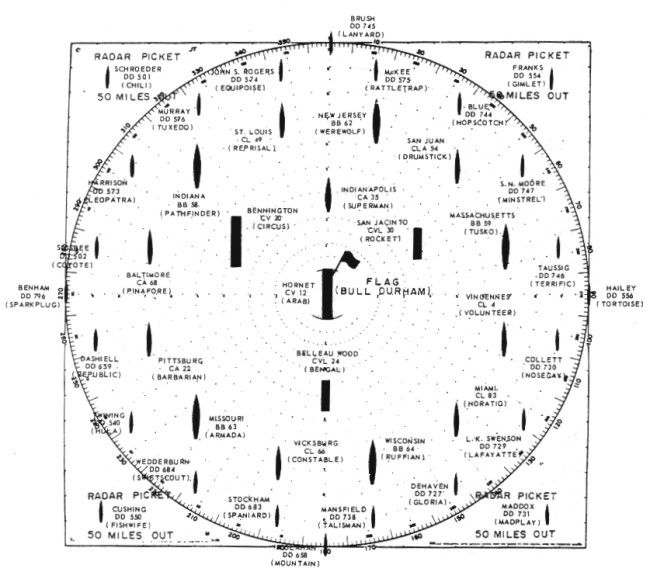
The Iowa class battleships brought 10 twin barrel 5" mounts, 20 Quad 40 MM mounts, and 49, 20 MM guns, which concentrated to put a wall of steel in front of any attacking foe, as the flag plot below showing five battleships surrounding four carriers will illustrate.

The effect of these great ships was also felt as they turned their main batteries to soften up every invasion beach after Guadalcanal which will be the subject of future post.

But for now, I want to pause to invite anyone reading this who has not already done so; to considering parting with a few dollars and becoming a Plank Owner on the USS Iowa as she prepares for a new mission of becoming the host of an education center and museum , devoted to preserving our naval heritage and the memory of those who served their country so valiantly. To those of you who live close to San Pedro, or in the bay area, where she currently needs volunteers to assist in painting and restoring her vast deck, I would invite you to fill out a volunteer pledge application and lend a hand in something you can tell your grandchildren about.


So in the immortal words of US Marine SGT Dan Daly,  lets see if we can all step it up and join the effort to make this the finest historical center on the world, devoted to our Naval heritage.