Showing posts with label Military History. Show all posts

Sunday, April 7, 2013

Miles S Burke, Forgotten Hero- Reposted in honor of Black History Month-

StM1c Miles S. Burke-1945
USS BUSH DD 529
 
This coming April 6th 2014 will mark the 69th anniversary of the sinking of the Fletcher Class Destroyer, USS BUSH DD-529 after being hit by three Kamikaze planes off Okinawa. The Bush, her hull almost cut in two, soon folded and sank, taking almost one third of her crew down with her.

The story doesn't end there. I became aware of the story of the USS Bush, when I volunteered to help restore the USS Iowa BB-61 to become a museum ship in San Pedro, CA. One of the volunteers Jim Pobag, related how his step-father had been a crewman on the Bush, Jim went on to tell the story of that final encounter with a swarm of Kamikazes, and the heroism of the crew as they fought for their lives. But first, the back story of the Bush and how she came to that fateful day.


The USS Bush joined the war in 1943, and recorded the following service history, prior to April 6, 1945.
Between 29 July and 27 November 1943 Bush acted as a patrol and escort vessel in Alaskan waters. Arriving at Pearl Harbor 4 December 1943, she commenced operations as a patrol, escort, and fire support ship throughout the Pacific, from the Ellice Islands to New Guinea, the Philippines, and Okinawa. She participated in the Bismarck Archipelago operations, including the Cape Gloucester, New Britain landings and the Admiralty Islands landings (26 December 1943 – 31 March 1944); Saidor, New Guinea, operations (18–21 January); Morotai landings (15 September); Leyte landings (20–24 October), Luzon operation, including the Mindoro and Lingayen Gulf landings (12–18 December 1944 and 4–18 January 1945); Iwo Jima operation (19 February–9 March); and the Okinawa operation (1–6 April).
On 1 November 1944, while operating in Leyte Gulf, Bush splashed two of ten Japanese planes during a severe air attack. She was showered by flying shrapnel and suffered two men wounded.
 
On April 1, 1945 the Bush took up station off Okinawa as this brief history describes. On April 6th the Bush was attacked and eventually breaks in two and sinks.
USS Bush, right center, behind smoke after being attacked April 6, 1945


I really became intrigued, when Jim related the bravery of one crewman who, although cited for saving lives, seems to have preformed his duty far beyond what was required of any sailor, and perhaps, like another sailor who preformed heroically at Pearl Harbor, might have been overlooked for a higher award, due to his race.

The man was Miles S. Burke, StM2c an African-American who due to the segregated policies at the time could only serve as a mess steward. When battle stations were called, Burke was assigned to the handling room team on the after most gun mount #5. Burke due to his size and massive strength, was remembered by his team leader in these words.
Robert Aguilar, SKD2c, was in-charge of that handling room crew and he remembers Burke well. Aguilar says of Burke, "He had all the physical attributes to make him the perfect individual for the job. In addition, he had the mental, emotional and moral strength to handle the situations we got into without breaking down when we needed him the most. It was obvious that he was more valuable to us than he was to the crews that had the mechanical hoists from the magazine to the handling room. He never complained the about the hard work; he worked all alone; and I don't remember Miles asking to be relieved even for a short period of time." Aguilar goes on to note, "What a sight to see that big muscle-bound body, shiny with perspiration, stay on the job like he did that day in Surigato Strait when we were under air attack for several hours and the temperature got like an oven in the handling room area."
 
Burke was so fast that he out preformed the other gun crews and according to Jim's stepfathers account, made it appear that the #5 turret has an automatic loading system. When the ship was badly hit, Aguilar had a hard time getting Burke to abandon his station.
 "When we were called to come topside, I had a hard time convincing him that the order meant him also, he did not want to leave his post."
 
Once topside, Burke moved forward to the aft engine space, where he entered and began to carry wounded crewman topside to safety.
Former Assistant Gunnery Officer Hilliard Lubin, Lt.(jg) had this to say about Burke, "I do remember .... his actions going down into the afire engine spaces at least 3 or 4 times to bring up one burned snipe each time. I can still see his bloody feet, but then shoeless. Being as big as he was, and deck hatches down to engine spaces as small as they were, how he got through I find hard to imagine now."
 
Miles Burke's heroism does not end there, after leaving the ship, he uses his strength to hold onto two men by keeping them afloat for five hours until rescued. Burke's actions were noted by his commanding officer CDR Westholm.
"BURKE's battle station was in the lower magazine of 5" gun #5. When his gun became inoperative he came topside and aided in the care and moving of the wounded. He did this in the face of the repeated air attacks on the ship. When forced to abandon ship he remained calm and was a source of constant encouragement to his shipmates. For a period of five hours in the water and on a raft, he supported two men unable to swim and who had lost their strength and one of which was without a lifejacket, thus saving their lives. When alongside the rescue vessel he assisted in getting those who did not possess their strength aboard."
 
Westholm, recommended Burke for the Navy and Marine Corps Medal which is awarded for:


The Navy and Marine Corps Medal is the second highest non-combatant medal awarded by the United States Department of the Navy to members of the United States Navy and the United States Marine Corps. The decoration was established by an act of Congress on August 7, 1942. The Navy and Marine Corps Medal may be awarded to service members who, while serving in any capacity with the Navy or Marine Corps, distinguish themselves by heroism not involving actual conflict with an enemy.
Miles S.Burke's who was also promoted to Mess Steward 1st Class, citation reads:
"For heroic conduct while attached to the U.S.S. BUSH following the sinking of that vessel in the vicinity of Okinawa, April 6, 1945. In the water and on a raft for five hours, BURKE supported two exhausted men who were unable to swim and one of whom was without a life jacket. His courage and perseverance were in keeping with highest traditions of the United States Naval Service."
 
Read the whole history of the USS BUSH from their web page.
USS BUSH DD529

As noted above, the Navy and Marine Corps Medal was to be awarded for non-combat bravery, which given the actions of Miles Burke, seems to fly in the face of history, since the action of Steward's Mate Burke certainly took place during combat, and most likely had he been a white sailor, would have at least rated the Silver Star, or even the Navy Cross. Much time has passed and it appears that Miles S Burke's image and the account of his shipmates is our only link to his bravery. I think that the Navy would be wise to revisit his actions and consider him for a higher award, or at least special recognition during their celebration of Black American History Month in February each year. Miles S. Burke is one "Fullbore" sailor who personifies duty and bravery in the face of the enemy in the highest traditions of the U.S. Navy and deserved to be recognized again. I will forever be indebted to Jim Pobag for making me aware of this man's bravery, and that of his fellow crew members on the USS Bush.


Sunday, November 11, 2012

In Reverse order: The Ugly, The Bad, and The Good, news of the week.

Iowa Vet "Mac" loving the flag and the ship
Photo Derek Cross
 
Petraeus, looking in the rear view mirror.

First the Ugly. The past couple of days have witnessed the downfall of someone whom most Americans admired and held in high esteem, General David Petraeus who tendered his resignation as CIA director, after it was discovered that he had an affair with a women, who in the course of collecting material for a biography, was almost inseparable during Petraeus's final months as the commander in Afghanistan. The curious thing about our changing attitude about indiscretions would probably have seen Eisenhower, Patton, and most certainly Admiral King and even President Roosevelt, removed from command during World War II, for the same weakness. One of the best pocket analogies of what might be going on, comes from fellow blogger Mark Safranski who hosts, zenpundit.com.

Mark sees both irony and a similarity in what he dubs a A Tale of Two Victories and Two Falls.
Ironically, one of the many Cabinet secretaries Nixon ignominiously fired in his bid to centralize power in his White House staff was his former 1968 primary rival, HUD Secretary George Romney, father of 2012 Republican nominee, Governor Mitt Romney. A blow from which George Romney’s political career never recovered. 
In looking at the Petrasus resignation on the eve of having to testify before Congress regarding the the Benghazi killings. Mark asks.
What however are the real issues? What should we be looking for?
Two things: As with Richard Nixon’s second term machinations, with such sweeping changes personnel changes in the offing for the Obama administration, ask yourself as events unfold: “Where is power flowing? And Why?”
If you do you will be in a better position to game out the direction of the next four years, especially in foreign policy and national security. 
Click on the link above, and take the time to ponder what Mark has written and check out the comments from Mr. X.

Badass US Marine signaling the enemy 
 Next we turn to the bad, as in "Badass". November 10th, marks the 237th birthday of the United States Marine Corps our preeminent "Badass" military branch. Two posts stand out. the first from Major General John A. Lejeune who penned this, on the 150th anniversary of  the corps.
The men recruited for this force were to be familiar life of the sea, but were to be trained as a military force, and was the intention to have them serve aboard the ships to be provided for the defense of the colonies. It is evident that the founders of the Marine Corps had in mind the fine services previously rendered by the British marines, both afloat and ashore, and that it was the intention to use the marines aboard the ships in naval battles when on the high seas and as landing forces when occasion might offer.
Read the whole article: November 10, 1775: The Birth of the Marine Corps

Chesty Puller and Dan Daly, outside legendary Tun Tavern
Photo duffelbag.com

And this, just in from the streets of Marine Corps Heaven:
THE STREETS OF HEAVEN – Trying to sit down for a quiet brew in Tun Tavern, the ghost of Dan Daly complained that once again the ghost of Chesty Puller “doesn’t know when to shut the fuck up.”
“We’re supposed to be guarding the streets up here, and I know our seventh general order is ‘talk to no one except in the line of duty,’” said Daly. “But there he goes, running his mouth to every new angel we get up here.”
Hi, I’m Chesty Puller. I won five Navy Crosses,” mimicked Daly in a girlish falsetto. “Shit, I’ve got one of those… right next to my TWO Medals of Honor.”
Like I wrote, "Badasses."
 Finally, the good. Today we pause to remember those who have served America and answered the call to arms. Most came home, and it is that day November 11th, that we honor  their service. This nation also pauses on Memorial Day, to remember those who gave their lives for the United States, but today is about those who also came home and regained their lives, many struggled and continue to try and heal in both mind and body the tribulations that comes with war. I was privileged to be aboard the USS Iowa this weekend where she was the backdrop for the City of Los Angeles first annual Veterans Appreciation Festival. The turnout was amazing, as veterans ranging from a few who served in the opening days of World War II, and continuing down the decades to active duty and even young ROTC cadets, lined up to walk the decks and be honored by the community and fellow citizens.
Iowa Veterans Appreciation Nov 10,2012
Photo Derek Cross
ROTC-San Pedro HS-and volunteer crew-USS Iowa
Photo:Derek Cross
 
Watching as men now in their eighties, some helped aboard by their proud families slowly made their way up the forward brow was an experience in humility as well as pride in our country. The moment they stepped aboard, their minds seemed to return to the period they served, and memories of so long ago. Many of these men will pass from our presence before the next Veterans Day, so it was especially important to make sure that every one of them was treated with the dignity and respect they had earned in their youth and carried forth over the generations to return one more time to a symbol of their youth and service. As my own Vietnam Generation edges closer to the winter days of our lives, making sure to honor those who preceeded us, know in their final days; that they were our "Greatest Generation."

Sunday, July 8, 2012

A Love Affair

Iowa #1 turret

I have a confession to make. I have fallen in love, deeply and overjoyed every time I am with her. I can't wait to rush down to visit her and crawl all over her magnificent frame and marvel at her every nook and cranny. I am speaking about my love affair with the USS Iowa BB-61 now open as a museum and education center at pier 87, in San Pedro, CA.

Robert Kent, CEO Pacific Battleship Center

The affair began from afar, when I first became acquainted with the efforts of the Pacific Battleship Center led by Robert Kent and company, to bring the Iowa to Southern California. However, I was not prepared for what happened a few weeks ago when I first stepped aboard her wooden decks and took my place alongside dozens of fellow volunteers willing to give up days off, to grind, weld, scrape, paint, replace decks, and haul all manner of material, in an effort to get her dressed for her grand opening. I wrote in a previous post about those first days and the intrepid crew that led the volunteers who make up the ship operations division. The story that unfolded since that first post, has become more than a brief footnote in this great ships lifetime, but an ongoing journey that sees men and women falling in love with  this ship and her history.

Last week, my brother, Vince, navy veteran, and former caretaker on the USS Hornet, came down for our annual visit, and being a fellow plank owner on the Iowa, joined me in bringing her to life. Our motivation was in part to honor the memory of our father, Jay Wade, Navy veteran of World War II, who served in the Pacific throughout the war. We left the house before dawn last Friday, and queued up on the dock to be checked by the diligent security team before bounding up the gangway. We then proceeded to a berthing space/wardrobe division, where we changed to blue coveralls, and then mustered in crews mess for our safety meeting and job assignments. Our fellow crew members ranged from young high school ROTC members, veterans, retired shipyard workers, and some who never served, but soon became shipmates, as devoted as any assembled in our country's history. After getting our assignments we dispersed in small groups where within a few minutes, informal leadership was established, along with the kind of bonding that can only occur when people do jobs that involve some level danger and skill.

Removing armored hatch, Wade brothers on the cheater bar. Mike Getscher on the torch
"Man against steel, man always wins." Mike Getscher, Chief Engineer, USS Iowa, 2012

As the day progressed, the bonding became as natural as mixing sugar and cream in coffee, until the perfect blend of teamwork led to a job being completed on time, and without injury. The common thread that surfaced in working with everyone in what is know as "Ship Ops" is the joy that kept everyone hard at work as sweat stained our caps and coveralls, and empty water bottles began to be strewn about like shell casings during a "Kamikaze" attack in 1945. Being a historian and an observer of people, the breaks between assignments gave me an opportunity to learn about my fellow volunteers, and what led them to work for the sum of hard work and toil. To a man and women, they all confessed it happened after the first day they stepped aboard. Many came with the idea of working a day or two as a way to see the ship. However, for all I spoke too, seduction stepped in, as the Iowa, being the grand lady she is, caused all who grace her decks and hallowed passageways, to fall in love with her magnificent body, and the spirit one can physically sense in every compartment.

Over the next four days, Vince and I, joined with our new brothers and a few sisters, to make the ship ready not for sea; but to receive hundreds of former Iowa crew members, and for the grand opening on July 7. As the countdown continued, deadlines had to be met, welding teams worked 24/7 to prepare the new brows, and our teams scrambled to hang fire extinguishers, rig emergency lighting, repair rails and ladders, and clear the deck, so as to pass the important fire inspections for safety and security.

Daily Breeze Photo: Robert Casillas

Monday afternoon July 2nd, saw the ship welcome the hundreds who had become "Plank Owners" by contributing money to fund the ship's restoration. They were joined by many veterans of the Iowa who were holding their reunion over the next few days. Those veterans showed that the love for the ship does not dissipate with time, but only grows deeper, and more moving. Old men stepped aboard, and within the blink of an eye, they became 20 again, as they returned to what for most, was the most memorable time in their lives. One fellow volunteer related taking a veteran who had been assigned to the engine room, down several decks, steadying his feet each step, as the veteran's caregiver held his arms. My fellow shipmate related that tears welled up in that old veteran's eyes when he entered the space where he entered adulthood so long ago, and for a moment, he shed scores of years as he told about working in the heat of the South Pacific so long ago. Similar images played out hundreds of times around the ship, as men showed their wives, children, and grand children where grandpa had lived and fought for his country.

For this old army veteran, it brought tears to my eyes as one realized that these men in the very twilight of their lives, sought for one more time to visit the woman who still held their first love. We who are volunteers have come to know the same feeling that inspired those men. I can not fully explain it, but here I am today making a public confession that I love that ship and cherish every moment I step aboard her historic decks.
Dedication ceremony July 4, 2012

This story is continuing to unfold. When the ship opened this Saturday July 7th, over 4000 people lined up to walk her decks and marvel at the power projected in her massive 16" guns. There is much more work to be done to open more of the ship to the public. Volunteers are welcome, but beware that this lady will seduce you, and steal your heart forever. I can not say enough about the leadership of this organization, our skipper Robert Kent, and his staff. Special recognition must be given to our own Lt. Dan, who as assistant ships engineer was the ramrod and spark plug behind our daily efforts. Dan, is a dynamo, who along with Mac our CPO, used the forum of our safety meetings to remind us all in a sonnet, that this ship was a lady who deserved respect, and would treat you right if you treated her right, and hurt you if you forgot to respect her and treat her like gold. Then there is volunteer, Jim Baca who was joined by his wife Sandra, and son. Jim alone, has volunteered over 700 hours the past nine months as the ships electrician/gunners mate, and is a wealth of information on the 16" guns. His wife a former navy veteran herself, remarked that they when they found the Iowa, volunteering was a natural as when they both first joined the Navy.

There are many others behind the scene, each of whom played an integral part in bring the Iowa to life. Some I came to know, like Robert's daughter Erin, who runs the wardrobe department, and always has a kind word for all who came to help. Then there is exhibit curator Dave Way, who worked tirelessly, to take a cluttered space, clean it up, and create a informative museum that showcases the history of the Iowa, and the heritage of battleships, while interviewing tour guide candidates, and planning for future exhibits. And finally, perhaps the hardest working of all, volunteer coordinator Sue Schmidt, who often was sending email up dates, (well after the bars had closed,) just to give you an idea of the time frame of her work day, as she coordinated the thousands of volunteer applications and scheduling assignments.

gunnersmate/electrician Jim Baca
Lt Dan and wife Vicky
Dave Way
Sue Schmidt

I wake every morning, longing for the chance to become a permanent member of her crew as the museum and education center become active. Until then, I will keep volunteering, and spending as much time as possible enjoying what for me, is both a time machine, a primary source for history to our country's maritime heritage, and now; one of the great loves of my life.

Yours truly, HG
Volunteer link
Virtual Tour of Iowa, LA Times

Wednesday, June 20, 2012

USS Iowa: Progress Report

Iowa in San Pedro
Volunteers on Iowa

Today I was privileged to spend the day on board the USS Iowa with dozens of motivated volunteers and a small dedicated staff who are literally working their tails off getting Iowa ready for the celebrations the will begin July 2, and continue as she hosts the USS Iowa Veterans Reunion and then her grand opening on July 7. The work already done in Richmond produced amazing results for a ship that was left absorbing the elements for over twenty years. Much work is still needed to get her ready, and what amounts to enough volunteers to almost fill her original complement, have stepped forward in such numbers to keep the scheduling staff working day and night, processing the applications of those willing to lend a hand.

This was my second day aboard the Iowa. Last weekend I joined up with a small group of strangers who soon became shipmates, as we went about the task of removing the walls of a petty officers lounge to make way for expanding the museum space. The task at first seemed daunting as the walls resisted our grinding tools that made little progress against what turned out the be honeycomb metal walls. We soon collectivly seized upon using a combination of metal saws and grinders to cut away the walls and open the space. Sparks flew, smoke spewed, and the ever present danger of fire, was suppressed under a careful watch. The walls soon gave way to present a new problem of how to get them topside. All the while, our little group continued to bond and in doing so, put our heads together to solve the problem of removing walls, then winching them topside through the hatch via a block and tackle. By the end of the day we were the tightest of shipmates, and left for our homes with a feeling of accomplishment, and even deeper, that sense of comraderie when you've made new friends.
Lt. Dan, Operations Boss
Today was no different, as the volunteers gathered in a crew dining space and awaited the safety meeting which is the daily benediction, before fanning out to the various assignments. Except for staff, most of the faces were new to me; except James a fellow volunteer from our Saturday crew. He and I were assigned to go with the Ship Ops Lead, Mac, to  raise the colors on the fantail, and them forward to raise the pennant on the bow. We then collected a half dozen ROTC students from San Pedro High, who had been coming aboard every day this week to lend a hand. The main task today was to move a large stack of life rafts racks to the side of the ship for removal to the dock. They were nested in rows below the barrels of number three turret and needed to be moved to the side of the ship where they would be hooked on to the forks of a lift and off loaded onto the dock. I must admit, it was challenging work, as we carefully untied the racks, stacked four high, and then by shear muscle power lifted then to the deck, and carried them to the rail, careful not to mar the wooden deck.
"Mac"
Our leader, was a former Iowa crew member who we will acknowledge as "Mac" who's first priority was doing it Safely, Safely, and more Safely!. The students worked along side old salts, and this old army guy, as we moved those heavy racks one by one to the side for offloading. Mac, kept everyone's head in the game with his ever present cautioning and if needed chewing out if anyone strayed from paying attention to the lurking danger associated with offloading such material. He demonstrated, then supervised the careful hooking of the straps, and calling out caution as each rack soared over the side onto the dock.  We them moved onto other assignments, each acomplished without a whimper of complaint, or any shirking to the task by old or young. The ROTC group consisted of five boys and one girl, who represented the diversity of Los Angeles and America today. Our next task was moving 60 cases of water, by forming a chain gang and passing the cases across the deck to a hatch where they were slid them down to the galley below and via chain gang moved snake like to a storage space. Again, us old guys were hard pressed to keep up with the enthusiasm of those students. During a break I learned that they were part of an Air Force ROTC program, and all planned to go into the Air Force, (too bad Navy, as they would make great sailors). All I can say is I tried to pitch them to consider switching services when they graduated.

I came away with two impressions, the first, that all of those who have volunteered, each feel a deep sense of commitment to the ship and the sea service. And second, they all share the feeling that they are part of a great enterprise, and take immense pride in working on the Iowa. Even more heartening, was my impression of the high school students who never once complained, or shirked from any assignment, and actually jumped at any task they were assigned. I am assured, that some of America's future leaders were among that group, and demonstrated the kind of grit and innovation that is a purely American trait.

Sunday, November 27, 2011

Fast Battleships: The Aegis System of World War II

USS Iowa plowing ahead on a new mission
Become a plank owner below

A month ago, I wrote about the New Mission for the USS Iowa BB-61 the lead ship of the last battleships build for the US Navy. Today, I wanted to revisit the Iowa and write a bit about the history of battleships in World War II, where their original mission to defeat the enemy fleet as decried by Alfred T. Mahan and his writings that had influenced naval doctrine since the turn of 20th century, was re-purposed to provide what we might dub the Aegis System of World War II.

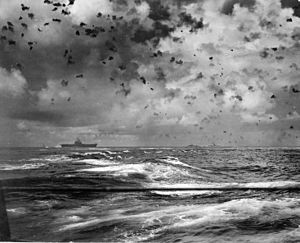
World War II saw the methods of sea control move from the barrel of  a 16" main gun battery to the air and under the sea. The battleships before the new classes of North Carolina and South Dakota could not keep up with the fast carriers, and consumed too much fuel to be deployed to support the early landings in the South Pacific. The newer classes arrived in the Pacific in October 1942, where they found a new mission of providing a massive platform for anti-aircraft guns to help fend off attacking planes that threatened the carriers. The Battle of Santa Cruz Islands, October 26, 1942 saw the effect of what the anti-aircraft firepower of the new battleships could do to protect a carrier. The American Order of Battle was divided into two groups; the USS Hornet, protected by two heavy cruisers, two anti-aircraft cruisers, and six destroyers, with a combined firepower of 72 5" DP guns and numerous 1.1 anti-aircraft mounts. The USS Enterprise group was protected by the USS South Dakota, one heavy, and one light cruiser and 8 destroyers with an equal battery of 1.1 anti-aircraft barrels and added 40 MM barrels on the South Dakota. The results of the battle saw the Hornet sunk, and the Enterprise damaged but surviving the onslaught of over 100 Japanese planes, with the South Dakota credited with shooting down 26 of the attacking planes by putting up 890 rounds of 5", 4,000 of 40MM, 3,000 1.1 and 52,000 rds. of 20MM.

South Dakota firing on Japanese bomber Oct 26, 1942

flak from South Dakota and San Juan
USS South Dakota Oct 26, 1942

I am not one to second guess history, but the concentration of having such a robust anti-aircraft gun platform as the South Dakota, supported by the antiaircraft cruiser USS San Juan CL-54 seemed to be the deciding factor in the Enterprise surviving to fight again. The effect of the lesser armed destroyers, in the Enterprise group was impacted when the USS Porter which carried no effective 5" guns, was accidentally torpedoed and required the assistance of another destroyer to rescue her crew in the height of the battle which potentially removed five 5" barrels from the fight. One can only surmise what would have happened it the Enterprise had been lost, or had there been no fast battleships ready to answer the call on the night of November 14-15, 1942.
As the war progressed, the six fast battleships were joined by the new Iowa Class ships, along with the their older sisters, re-floated, and re-armed with scores of anti-aircraft guns that produced such a volume of fire that when used with the new proximity fuse shells, saw no further losses of battleships or fast carriers, with only the light carrier USS Princeton being sunk during the battle of Leyte Gulf. In a time before guidance systems like the AEGIS, the battleship was the last line of air defense during the horrific final months of the Pacific War.


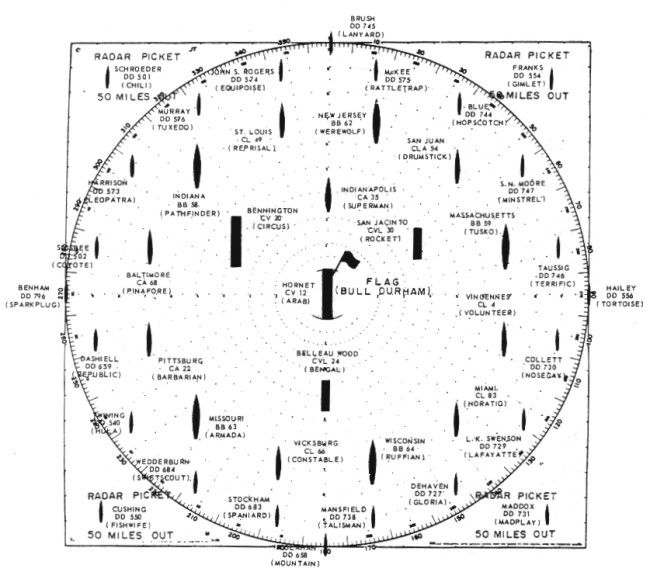
The Iowa class battleships brought 10 twin barrel 5" mounts, 20 Quad 40 MM mounts, and 49, 20 MM guns, which concentrated to put a wall of steel in front of any attacking foe, as the flag plot below showing five battleships surrounding four carriers will illustrate.

The effect of these great ships was also felt as they turned their main batteries to soften up every invasion beach after Guadalcanal which will be the subject of future post.

But for now, I want to pause to invite anyone reading this who has not already done so; to considering parting with a few dollars and becoming a Plank Owner on the USS Iowa as she prepares for a new mission of becoming the host of an education center and museum , devoted to preserving our naval heritage and the memory of those who served their country so valiantly. To those of you who live close to San Pedro, or in the bay area, where she currently needs volunteers to assist in painting and restoring her vast deck, I would invite you to fill out a volunteer pledge application and lend a hand in something you can tell your grandchildren about.


So in the immortal words of US Marine SGT Dan Daly,  lets see if we can all step it up and join the effort to make this the finest historical center on the world, devoted to our Naval heritage.

Sunday, October 9, 2011

A Promise to Remember a Life Lived


Scott A Christofferson 1947-1967


Yesterday October 8th, marked the 44th anniversary of the death of Specialist 4th Class Scott Christofferson, in Vietnam. I did not know Scott, and only became aware of him when a co-worker and nephew of Scott's sent out a small email message to the staff commenting on the anniversary of his uncle's passing and bringing attention to a little book that was published from a collection of his letters home. I first wrote about Scott two years ago and in pausing to remember a fellow soldier I am reprinting it in full.
Something happened today to bring memories flooding back of a time that I mostly try and keep locked away only to be visited in the company of those who have also held the lance. This morning, a young man sent out an email to all the employees where he worked, asking them to take a moment and remember his uncle Scott, whom had been killed in action on this date, October 8, 1967 while serving with the United States Army in Vietnam. He asked that those who got the email to visit the a youtube link to view a tribute to his uncle.
When I opened the link and began to watch, I saw the face of not only Scott, but the faces other's who had answered the call so long ago, smiling back at me like a mirror into my past. I came face to face to the reality that I lived on, and here a talented young man, who perished in the very flower of his youth is sending a message to the generations about service and commitment.
God in in his wisdom gave Scott a special talent to be able to convey his thoughts to paper. What follows is a little background on who Scott Christofferson was and continues to be, to those who chance to read his words.


The third of eight children to be born to Frank and Barbara Christofferson, Scott Christofferson was one of the original baby-boomers, born in Baltimore, Maryland, in November of 1947, less than 2 years after his father’s return from his tour of the South Pacific as a decorated Navy fighter pilot in World War II. The family eventually settled in St. Louis, Missouri, where Scott attended high school, graduating in 1965, and moving on to the University of Missouri-Columbia, where he hoped to major in journalism. He was an aspiring writer when he dropped out of college after just one semester, choosing to see the world first-hand as an enlisted GI-turned combat reporter during the turbulent Vietnam years.
Here is what I discovered about Scott and how he met his death in Vietnam. Scott served with the PIO section of the HQ Company of the 1st Brigade 101st ABN Division. He volunteered to become a combat reporter and soon began to travel with the 2BN 327th Infantry on their missions. On October 8, 1967 he was on a mission with A Company near Tam Ky when they were hit by two reinforced companies of North Vietnamese. Scott, joined in providing covering fire to allow his fellow soldiers to withdraw and refused to leave his position until all had been safely withdrawn. Scott was killed during this time. He was awarded the Silver Star , Bronze Star and Purple Heart for his valor, forty two years ago today.
Almost fifteen years after Scotts death, his younger sister Carrie discovered a box of his letters forgotten in a closet in her mothers home. After reading them she realized that they revealed a person whom deserved to be remembered for more that being a hero. She edited those letters and published them in a book to pay tribute to her brother and as she writes.
"We believe others will be able to gain insight into that period in American history by reading these letters, to develop an appreciation for the young men and women who sacrificed their youth in the jungles of Vietnam, and perhaps most significantly, to know well one specific young man whose journey from college dropout to Army combat reporter to fallen hero is brought to vivid life through his own words."
Buy Your Hero and Mine, Scott

On passage in Scott's book written  jumped out at me when I came across it as it introduced the final chapter entitled October 8, 1967. It was almost a perfect paraphrase of one of my favorite passages, written by another hero, Brigadier General Theodore Roosevelt during World War II.

Roosevelt wrote:
"The longer I live the more I think of the quality of fortitude--men who fall, pick themselves up and stumble on, fall again, and are trying to get up when they die."
Scott wrote:
"The jaded man stumbles again; for the last time. He tries with all his strength to regain his feet, But his muscles are all played out with past efforts, He dies struggling to stand once more, He dies grimacing with trial, But struggling with a faint sweet smile, For he knows he has lived."
After reading about Scott, I see how close the degrees of separation were in our paths. I too dropped out of college and joined the Army to serve my country. I was just a year older and for most of my time in Vietnam was also in and out of direct harm, in similar ways that Scott found himself. I was luck to find a small video tribute that his family had posted and share it below.
So as I sit here and watch that little clip and wipe the mist from my eyes, I say a silent prayer in the knowledge that I will remember Scott Christofferson and a promising life cut short, but given a measure of immortality in the little book he left behind.

Sunday, May 29, 2011

Memorial Day 2011

American Military Cemetery Cartage, Tunisia

Cartage,Tunisia

American Military Cemetery, Manila-16,631 at rest.

American Cemetery Luxembourg


Memorial Day is a day to remember those who have given their lives in the service of our nation. For anyone who has served, the day takes on a special meaning because we shared the same bond of service. I have written before of those we remember  on this day. This year, I want to share a passage written by Rick Atkinson author of Army at Dawn: The War in North Africa, 1942-1943. This excerpt from the prologue is one of the most moving passages ever put to ink.
Twenty-seven acres of headstones fill the American military cemetery at Carthage, Tunisia. There are no obelisks, no tombs, no ostentatious monuments, just 2,841 bone-white marble markers, two feet high and arrayed in ranks as straight as gunshots. Only the chiseled names and dates of death suggest singularity. Four sets of brothers lie side by side. Some 240 stones are inscribed with the thirteen of the saddest words in our language: "Here rests in honored glory a comrade in arms known but to God." A long limestone wall contains the names of another 3,724 men still missing, and a benediction: "Into Thy hands, O Lord."
This is an ancient place, built on the ruins of Roman Carthage and a stone's throw from the even older Punic city. It is incomparably serene. The scents of eucalyptus and of the briny Mediterranean barely two miles away carry on the morning air, and the African light is flat and shimmering, as if worked by a silversmith. Tunisian lovers stroll hand in hand across the kikuyu grass or sit on benches in the bowers, framed by orangeberry and scarlet hibiscus. Cypress and Russian olive trees ring the yard, with scattered acacia and Aleppo pine and Jerusalem thorn. A carillon plays hymns on the hour, and the chimes sometimes mingle with a muezzin's call to prayer from a nearby minaret. Another wall is inscribed with the battles where these boys died in 1942 and 1943 -- Casablanca, Algiers, Oran, Kasserine, El Guettar, Sidi Nsir, Bizerte -- along with a line from Shelley's "Adonais": "He has outsoared the shadow of our night."
In the tradition of government-issue graves, the stones are devoid of epitaphs, parting endearments, even dates of birth. But visitors familiar with the American and British invasion of North Africa in November 1942, and the subsequent seven-month struggle to expel the Axis powers there, can make reasonable conjectures. We can surmise that Willett H. Wallace, a private first class in the 26th Infantry Regiment who died on November 9,1942, was killed at St. Cloud, Algeria, during the three days of hard fighting against, improbably, the French. Ward H. Osmun and his brother Wilbur W., both privates from New Jersey in the 18th Infantry and both killed on Christmas Eve 1942, surely died in the brutal battle of Longstop Hill, where the initial Allied drive in Tunisia was stopped -- for more than five months, as it turned out -- within sight of Tunis. Ignatius Glovach, a private first class in the 701st Tank Destroyer Battalion who died on Valentine's Day, 1943, certainly was killed in the opening hours of the great German counteroffensive known as the battle of Kasserine Pass. And Jacob Feinstein, a sergeant from Maryland in the 135th Infantry who died on April 29, 1943, no doubt passed during the epic battle for Hill 609, where the American Army came of age.
A visit to the Tunisian battlefields tells a bit more. For more than half a century, time and weather have purified the ground at El Guettar and Kasserine and Longstop. But the slit trenches remain, and rusty C-ration cans, and shell fragments scattered like seed corn. The lay of the land also remains -- the vulnerable low ground, the superior high ground: incessant reminders of how, in battle, topography is fate.
Yet even when the choreography of armies is understood, or the movement of this battalion or that rifle squad, we crave intimate detail, of individual men in individual foxholes. Where, precisely, was Private Anthony N. Marfione when he died on December 24,1942? What were the last conscious thoughts of Lieutenant Hill P. Cooper before he left this earth on April 9, 1943? Was Sergeant Harry K. Midkiff alone when he crossed over on November 25,1942, or did some good soul squeeze his hand and caress his forehead?
The dead resist such intimacy. The closer we try to approach, the farther they draw back, like rainbows or mirages. They have outsoared the shadow of our night, to reside in the wild uplands of the past. History can take us there, almost. Their diaries and letters, their official reports and unofficial chronicles -- including documents that, until now, have been hidden from view since the war -- reveal many moments of exquisite clarity over a distance of sixty years. Memory, too, has transcendent power, even as we swiftly move toward the day when not a single participant remains alive to tell his tale, and the epic of World War II forever slips into national mythology.
Tens of thousands of Americans lay like those above; in cemeteries, unmarked loam and jungle sand, far from the place of their birth. I can attest for every one, that in their youth, none imagined their bones would rest forever so far from home. Today, the nation goes to extraordinary measures to bring their fallen sons and daughters home. For most of the nation, the wars of the past decade have not left them wounded with the loss of a family member or even anyone they have personally known. The lives lost in earlier wars are distant and fleeting, only remembered if those lost were a parent or a relative.

Hopefully, this post and those by other unfettered hands posting scores of tributes on this medium and across the social media, will give pause to everyone to remember how much their current lives were impacted by fellow citizens who gave their lives to insure the freedom of the next generation. I am especially speaking to the millions born and those who have come to these shores in the years since World War II and the wars spawned of the Cold War. Your lives would not be the same without the sacrifice of souls like those remembered above.

So I say, lift your glass just once this long weekend, and pause and utter a small remembrance to those who made it possible for you to have the chance to live in a world of opportunity versus a world of permission. The greatest redemption for their loss, is making sure your life is worthwhile.

Saturday, April 9, 2011

USS Iowa BB-61: Update

USS Iowa leading the fleet
USS Iowa training out her guns
USS Iowa in rough seas
Iowa coming home
Anyone who has visited or given this blog more than a casual glance will recognize I take a great interest in the United States Navy and especially their role in the Pacific during World War II. A few day ago I wrote about the possibility that Southern California will soon be the home port for the newest addition to a long list of navy museums that preserve and honor our naval heritage.
Scale model of USS Iowa at Pier 87
Model overview of pier 87
Today, I attended a special event at pier 87 in San Pedro , once home to the Battle Fleet before 1940 and major shipyards during World War II and after. The event was to gather support for a California Assembly Resolution to support awarding the battleship USS Iowa BB-61 to San Pedro, with a new mission of offering education programs in history, leadership, team-building, character development, and community service, as well as serving as a disaster control center. First and foremost, ship will assume a unique "Living Museum" role that will provide visitors with an "at sea" experience that will trace the Iowa's 50 year history.

Fire boat Warner L Lawrence
USS Iowa being moved
If all goes according to plan, the dog days of summer will see Los Angeles Fireboat Warner L Lawrence  leading a parade that welcomes the Iowa to her new home at Berth 87 . The support for this project has been astounding and includes former President George H. W. Bush , community, state, business and veterans organizations. As things move along and the final details are worked out this blog will keep you posted and give plenty of notice to invite all to come welcome this great lady to her new home.

In the coming years, as the memory of World War II and the Cold War fade with the passing of the greying veterans amongst us, this ship will live on; to offer a hallowed space for future generations to contemplate what it was like when men steeled their hearts, to sail such ships into teeth of fascism and totalitarianism.