Showing posts with label Grand Strategy. Show all posts

Sunday, February 10, 2013

Plotting a Course Correction into Well Know Waters


Dr. Thomas PM Barnett 
 

Part of what makes a person a visionary strategist, or a master navigator, is being able to recognize changes in the wind, and recommend course changes to those tasked with commanding, be it a ship or a nation. This past week Thomas PM Barnett, who by his own admission, has for a long  time suggested that the United States abandon the old world alliances, and cast her lot with the new kids on the great power block, China and India. However, as Barnett explains in an article penned for World Politics Review, he now recommends staying the course with our European allies by renewing our bonds of shared values, and past experiences, as the United States sets her strategic course over the next twenty years. Barnett writes in part.
Readers familiar with my old column here will remember how I’ve taken to describing that 2030 future as the C-I-A world, as in, one run by China, India and America. But recently, thanks to a series of long-range simulations run by Wikistrat, where I serve as chief analyst, I’ve found myself thinking that renewing the trans-Atlantic bond with Europe may be the best way to assure the right kind of U.S. global leadership as we move toward that 2030 horizon.

Today’s globalization is suffering a populist blowback on a nearly global scale. Indeed, the only places not suffering such blowback are Latin America, Africa and Southeast Asia, frontiers where globalization’s widespread wealth creation is still resulting in very positive outcomes. Just about everywhere else, whether in the old West, the rising East or the Arab world, we’re seeing a build-up of social anger at globalization’s inequities and excesses that is stunning in its scope and persistence. In short, the world seems destined to either re-balkanize itself over these tensions or enter into a lengthy progressive era that corrects these imbalances and cleans up these corrupting trends...
 
Barnett goes on to make this conclusion, and offers this recommendation why the United States should to set her strategic sights along side the EU and NATO, to navigate what appears to be troubling waters over the next two decades.
When you look at America’s competition with India and China in this light, you start to realize that neither of those two Asian giants really has anything to teach this country. Instead, both are doomed to cover a lot of difficult ground that our system has already mastered. They need to “play up” to America’s developmental level, not the other way around.
So, if the U.S. is really looking for a strategic partner for further co-evolution amid a second Progressive Era, our natural choice is Europe. We have the same problems -- and the same strengths. We share common languages and heritages. We know how to screw up globalization (World War I), and how to rebuild it even better (the U.S.-engineered international liberal trade order following World War II). 
And just as importantly, we know how to handle bullies given over to feverish bouts of nationalism.
 
Read the whole article: Trans-Atlantic Ties Still Key to Renewing U.S. Global Leadership

Azores
PLA-Navy

Renewing the ties might have an even more pressing motivation as this post up this week at Center for International Maritime Security. Where a post by Felix Seidler, a fellow at the Institute for Security Policy at the University of Kiel, Germany, writes about a possible move by the PLA-Navy into the Atlantic.

On his way back from a trip to South America in the summer of 2012 China’s Premier Wen Jiabao made the strangest possible stopover. He landed on an American-Portuguese air base on the Azores. The Lajes Field Air Force Base is one of many on the Pentagon’s list to be reduced or scrapped.

Seidler then went on to describe his own less view of this possible development.

However, terror-filled visions of Chinese aerial patrols over the Atlantic are out of place. How would the aircraft, including personnel and equipment, get there? And what types of aircraft could perform such feats? China’s military is not blessed with too many long-range bombers or maritime patrol aircraft. Even if they had such capabilities, why should China try to send men and material, strongly needed in the Indo-Pacific, to the other end of the world? From these current practical limitations it would be easy, but wrong, to stop the discussion about China’s role and potential operations in the Atlantic.
This new development in the territory of a NATO country must be seen in the context of China’s efforts in another NATO member, Iceland. China has heavily invested in the country’s ports and infrastructure because Beijing in the long-term expects an ice-free Arctic to open new shipping routes. Meanwhile in Greenland, whose foreign policy is administered by NATO member Denmark, vast quantities of important resources have also caught China’s eye and spurred development plans.

China is attempting to protect and project its strategic interests in the Atlantic and is doing so within NATO countries. This broader trend should not be dismissed without broader analysis. Such moves – note the plural – are something entirely new.

Seidler cautions that before everyone in the West declares a state of emergency that everyone calm down.

For the foreseeable future, what China does in the Atlantic will have zero operational military relevance. The strategic and political implications are what matters. In London, with its own not-inconsiderable South Atlantic interests, and in Paris, these geopolitical developments will be watched closely. Washington, London, and Paris are likely able to bring enough pressure to bear on Lisbon that China will not settle on an island in NATO’s heart. The unknown variable is debt. Will Beijing buy so many Portuguese bonds that Lisbon cannot say no? Or will Europe exploit Portugal’s dependence on Euro rescue funds for its geopolitical aims to eliminate any designs China has on the Azores? We will see.

Seidler's recommendation dovetails with Dr. Barnett's urging a re-newing of Trans-Atlantic alliance and the expanding role of NATO in forging cooporation verus confrontation with an emerging China.

There is a lot to doubt about China’s intentions. The growing nationalism, the behavior in cyberspace, and the more aggressive stance in the East and South China Seas speak for themselves. Nevertheless NATO Europe must focus on cooperation rather than confrontation. The reality is that the U.S. and NATO have already developed templates for successful cooperation with China’s navy off the Horn of Africa. Such measures should be continued and expanded, for example with counter-piracy, humanitarian assistance, and counter-terrorism efforts. However, the reality is that China is also developing its navy as an instrument of Indo-Pacific power projection, which will have the side-effect of enabling it to pursue its interests in the Atlantic stronger than before.

Read the whole article: Will China’s Navy Soon Be Operating in the Atlantic?

 
As one who participated in the same long term simulation that Dr. Barnett referred to in his article, I too have reached similar conclusions. Without going into detail about what is currently a confidential simulation, it was readily apparent to me that Europe with all her attendant problems, is also set for a course correction that sees the possibility of countries like Sweden and Finland joining NATO. Another development sees Germany after unsheathing her saber in Afghanistan realizing that they need to be more expeditionary and assume a responsible role in policing the global commons. Their plan to launch several long range F125 Frigates reflect the awareness of those responsibilities. Other European Nations are also building vessels that are designed to extend their reach across the global commons in a policing manner. This dovetails well with the current force structure of the U.S. Navy that retains the ability to play the leviathan force, capable of global reach.


Sunday, February 3, 2013

My Own Pivot to the Sea

Admiral Greenert, Gen. Amos and Admiral Papp 
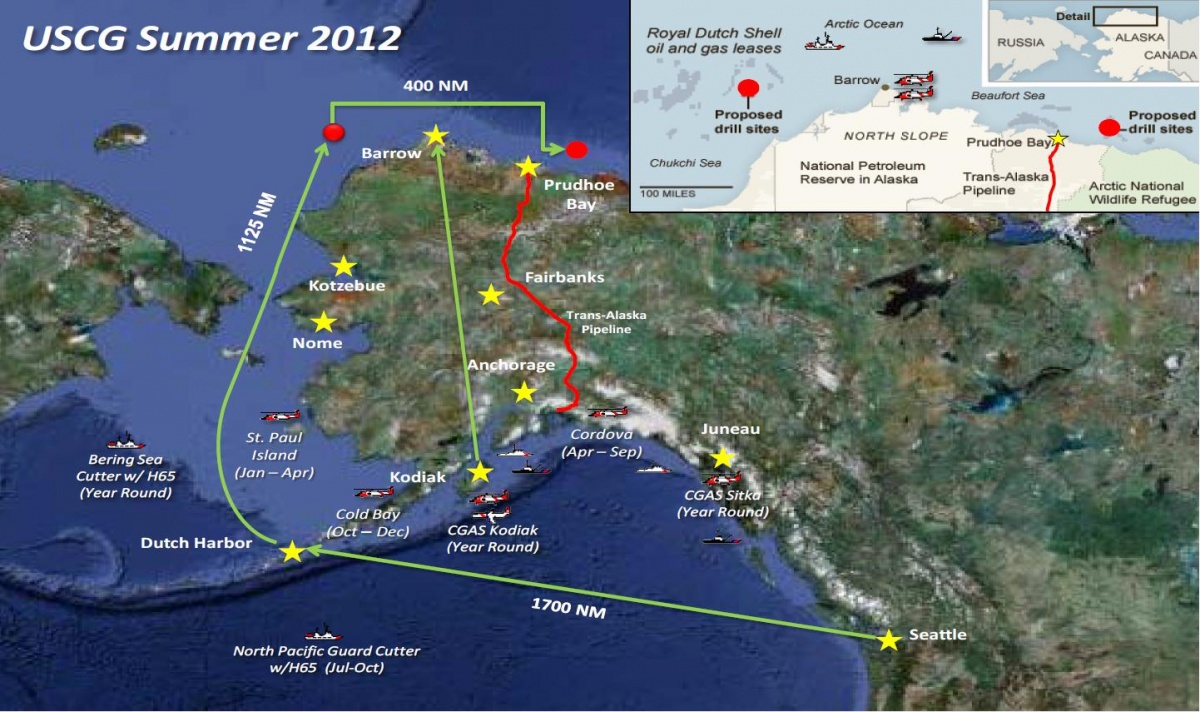
Coast Guard NSC deployment to Arctic in Summer of 2012
The focus of this blog for the past five years has often been on the ongoing efforts by our land forces in Iraq and Afghanistan as they attempted to confront a landscape that provided fertile ground for ideologies who resisted the connectivity spreading across the planet in the past twenty some years since the end of the Cold War. The efforts of the United States and her allies will have to wait the test of time to see if any worthy legacy will honor the cost in lives, treasury and the loss of focus on other areas of our security, most evident in the maritime arena.

In that vein, I am going to be devoting even more attention to our sea services and the importance of owning the legacy of being a maritime nation. I have added a heading for blog links devoted to naval centric topics and encourage all to read them frequently.

This past week I was privileged to attend the West 2013 Conference in San Diego, where I was able to attend several panel discussions and a very informative luncheon where the guests were the Chief of Naval Operations ADM Jonathan W. Greenert, Commandant of the Marine Corps Gen James F. Amos, and Commandant of the Coast Guard ADM Robert J. Papp Jr. who participated in a round table discussion of the future of the sea services. I have linked the video below, and encourage all to take an hour to listen carefully the their words.

Another, panel I attended discussed the Chinese Navy and her intentions, be they a challenge or a potential partner in maintaining safe passage for all maritime global commerce. That video is also below.
LCS's Independence and Freedom
One major naval centric blog, Information Dissemination, saw the return to frequent blogging by their astute commander, Galrahn who in this post, questions the value of the LCS class ships, and invited this guest post by Robert 'O Work the Under Secretary of the Navy. Excellent posts by both gentlemen as well a give and take in the comments sections.

Chinese shipyard

Mirroring some of the concerns voiced by the panel on Chinese Naval intentions, Galrahn posted this piece that if the Chinese take a page from FDR's Depression era shipbuilding program, will protend a fleet three times larger than today's by 2020. Galrahn concern is the following.

What does the PLA Navy look like if the Chinese decide to retain their shipbuilding sector through this downward economic period by keeping only 30 (~15%) of their major shipyards open via governemnt orders? I don't know what that would look like, but I will note that 30 major shipyards building navy ships is the same shipbuilding capacity the United States leveraged to build all warships in World War II. While no one would expect China to field ships at the same pace the US did in WWII, even if China adds orders of a single large PLAN vessel or multiple smaller vessels for 30 shipyards over 5 years while sustaining current construction pace for PLA Navy and government maritime agencies, the size of the PLAN and associated government maritime agencies could potentially triple by 2020.
Now tell me what it looks like if the Chinese government sustains 30%, or even 50% of their shipbuilding sector with government orders for PLA Navy and government maritime agency vessel orders. In theory, the Chinese government could decide to build their own 1000 ship Navy over the next 5 years by simply buying 2 ships at only 100 of their large shipyards for the sole political and economic purpose of saving the 50% of shipbuilders who are expected to go out of business over the next 2-3 years, with the very real alternative being that all those manufacturing workers become unemployed.

If this is a topic of interest, read the links. All of them. For the record, the title is a Chinese proverb that when translated literally means 'when the wind of change blows, some build walls, while others build windmills.' It is another way of saying it is better to adapt than to be stubborn. When I think about the variety of topics discussed, I thought the proverb fit, not just the Chinese but us as well.
 
Read the whole post: 风向转变时,有人筑墙,有人造风车


Sea Service Chiefs Round table West 2013
 
Panel: Chinese Navy: Operational Challenge or Potential Partner?


Sunday, August 12, 2012

Let's always speak softly people, and carry a "Big Stick."

USS Iowa
Container ship unloading at Port of Los Angeles
Photo LA Times
The past few weeks the focus has been nautical as I have been writing about being a volunteer helping to restore the USS Iowa BB-61 from a state of suspended life, to a return to glory as a museum and education center. The ship is berthed along the main channel for the Port of Los Angeles where the guests and staff are treated to the daily arrival and departure of all manner of commercial vessels carrying the bulk of global commerce that fuels the rise of a global middle class. When a great container ship comes up the channel people gather on the port rails to gaze in amazement as these great ships make their way up the channel. For most of the people on the ship, this is the only opportunity to experience how connected the United States is to the rest of the world. Watching their reaction and having the opportunity to speak to many of them as they voice their new found awareness, led me to pen this post.
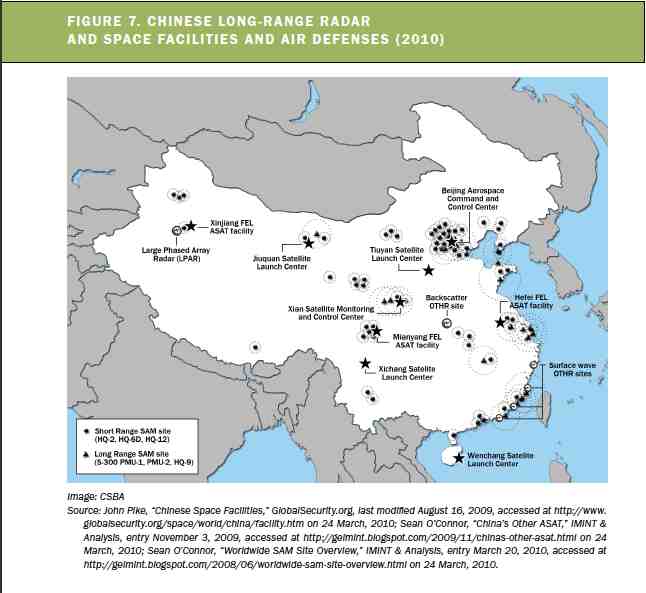
From the CSBA report on the ASBC: the section entitled "Blind PLA ISR Systems."
As our armed forces begin to find a way to extract ourselves from what has turned into a war of attrition in Afghanistan, the focus has turned to the sea and the discovery that our influence is adrift in many areas. Some voices are doing all they can to do what might be seen as "tagging" in a political sense by publicly releasing bombing targets to be sought in the opening rounds of a Sino/US conflict. Saner voices have begun to point out the inconsistency of our position as noted in this post from Thomas PM Barnett in Time's Battleland online, where Barnett pulls no punches in his criticism.
Nice Washington Post piece (by Greg Jaffe, of course) on the great COIN counterattack that is the Pentagon’s AirSea Battle.
As scenario work goes, what the Center for Strategic and Budgetary Analysis has done in its war-games has to rank right up there with the most egregiously implausible efforts ever made to justify arms build-ups.
Read more: AirSea Battle: The Military-Industrial Complex’s Self-Serving Fantasy

On the Beach (1959)

Barnett was just getting wound up in his desconstruction of this concept and continued write more on the topic, by commenting and linking an analysis by an Australian strategist who if we recall the film On the Beach  is about the last place standing after a bunch of great powers pulled the ultimate trigger.
AirSea Battle calls for deep strikes on the Chinese mainland to blind and suppress PLA surveillance systems and degrade its long-range strike capabilities. Such an attack, even if it relied solely on conventional systems, could easily be misconstrued in Beijing as an attempt at pre-emptively destroying China’s retaliatory nuclear options. Under intense pressure, it would be hard to limit a dramatic escalation of such a conflict – including, in the worst case, up to and beyond the nuclear threshold.
 Barnett adds his own comments and literally calls out loudly the reality of pulling the trigger in a hope of preserving US hegemony.
Keeping China from doing something truly stupid in East Asia is not hard. We need to undermine their asymmetrical approach by - as this article argue - creating our own, and NOT by setting ourselves up for a rapidly escalating great-power war. Bombing the length and breadth of China in the opening hours of some crisis is just plain stupid and reckless and painfully unimaginative. This is a massive retaliation response that pretends China isn't a nuclear power capable of significant retaliation.
Sometimes I feel like I'm the only person who hasn't taken the crazy pill on this one: YOU DON'T CONDUCT WIDESPREAD BOMBING CAMPAIGNS AGAINST THE HOMELANDS OF NUCLEAR POWERS!
Why is Thomas Barnett right on this isssue? It is written in his next post, which goes hand in hand with those container ships that slide past the USS Iowa on a daily basis.
Point being, we are locked in a symbiotic relationship with China. There is no good global economy without us and there is no good global economy without them.
 This is what gets me when Pentagon strategists casually consider war with China, to include direct attacks on the Chinese homeland. What happens to the global economy when the two intertwinned biggest national economies decide to start blowing each other's citizens up? The global economy would tank at a speed that would stun everybody. There wouldn't be any days or weeks of bombing campaigns. We'd have global economic turmoil of a stunning nature well before that, as the markets would freak out.
And this final spot-on broadside from Barnett's keyboard.
Beyond that fantastic scenario extension lies CSBA’s plans to basically destroy the entire Chinese air force and submarine fleet, plus institute a “distant blockade” that would see us interdict and search—and here the irony balloons—China’s seaborne trade, which ought to be fairly simple since so much of it involves the US economy. And because it’s not easy to stop committed large ships (don’t tell Somalia’s pirates), CSBA broaches the notion of using Air Force bombers to “provide ‘on-call’ maritime strike.” One can only imagine how many thousands of Wal-Mart containers the US military could send to the bottom of the Pacific before the White House would hear some complaints from the US business community. But why let that reality intrude?

Read more: A complication that displays the interdependency between the Chinese and US economies

Now I am a realist, as well as being a bit of a hawk in the area of defense, but Barnett makes sense on this one.

The interest of the United States strategically remains and has always been to preserve our interests as a maritime nation and having not only a strong navy, but a solid strategy is the bedrock principal in continuing to lead that role. It seems that other's are sensing the same thing. Several new blogs have appeared in the past couple of months to join the bevy of excellent sites like Information Dissemination, and US Naval Institute Blog. Two of the most active are the Center for International Maritime Security and most recently, The Diplomat's Flashpoint.  Naval centric topics have joined the list of simulations on Wikistrat "When China’s Carrier Group Enters the Persian Gulf".

My advice is for everyone to keep their powder dry and their nukes locked shut and take the time to ponder how we can all share this blue, as in mostly covered in water planet in peace. Being prepared is essential to a nation's survival, but bluster, and veiled threats of insured destruction, are about as productive as announcing that your planning to negotiate a new loan, while seated across from the banker, fully armed and wearing combat gear and twirling your pistol. In the best traditions of our country, we have always managed our way through over a century of being a great power by following Theodore Roosevelt's admonition to "Speak softly, and carry a big Stick." It is not lost that the USS Iowa's nickname is "Big Stick."


Saturday, January 28, 2012

West 2012-The Navy and Marines in the next decade


US Navy
US Marine Corps


This past week I had the pleasure of attending the WEST 2012 Conference in San Diego, where the theme was America's Military at the Crossroads: What's Out and What's In for 2012 and Beyond. I was encouraged to attend by the involvement of the event co-sponsor, the United State Naval Institute. The USNI has been in the forefront of offering a platform where those with an interest in the Navy and all the attendant aspects of strategy, history and tactics are given a forum to express and discuss their interests. The attention to the future of the sea services became all the more important in the recent changes being described as the "Strategic Pivot" to face west into the Pacific and prepare to confront what some see as a potential adversary, China, as she builds her own blue water navy. How big is this threat? Are we building the right fleet, or are we building a fleet based on the last major war WWII? What in the light of the current economic times, can we afford to build. And finally, what kind of Sailors and Marines and leaders do we need for the next two decades and beyond? Those are some of the questions that the conference's many panels attempted to answer.

ADM Mike Mullen

I was able to attend some of the many panel discussions and was able to hear former Chairman of the Joint Chiefs, Admiral Mike Mullen (ret), as he spoke of his vision and hopes, for the future of our defence strategy and the needs to return to the traditional role of the Navy, as both an instrument of war, and diplomacy. Now retired, he gave a visionary speech, that was refreshing in the lack of boilerplate rhetoric that some still in uniform were obligated to profess in their comments.

UltimaRatioRegis
Col Merritt Edson, USMC
As noted above, I attended because of the USNI, and had the opportunity to become acquainted with several of the major contributors to their fine blog. I had know of one young petty officer, from his posts and another who wrote under the name of UltimaRatioRegis: The Last Argument of Kings . My first introduction to  these two fine men, came during the question and answer part of a panel discussion on whether the Navy and Marines would "Hang together, or Hang Separately." I looked up to see a Petty officer standing behind the mike, where he proceeded to ask the two admirals about the quality of shipbuilding, using the example of the well known problems of his former ship, a class leader as the example. I instantly recognized him, as the young petty officer blogger noted above, and was impressed by his eloquence as he addressed the flags. The next question was raised by a Marine Lt. Col. who was reminiscent of famed Marine Col. Edson in his demeanor and the directness of his questions to the panel. His message to the panel was that the Marine Corp return to the fundamentals that were the same as those developed in 1943-44, that forced entry needs to breach the beaches in order to have a place to bring the supporting elements for a prolonged campaign. Later, I learned he was the one making the "Last Argument of Kings" from above. The point of mentioning these two gentlemen, is to reflect the quality of those who express their views on the USNI blog, and have the stones to stand before an esteemed panel and really speak for the thousands of sailors and marines who trust that those in the flag rank, the civilian leaders, and the suppliers of all manner of tools for the service; understand that the trust of the men and women in their equipment and leadership is in their hands. One would hope that those leaders, will heed the concerns from the rank and file, and step beyond the personal motives of managing their careers, or landing a future post-retirement job with a supplier, and step up to leave a lasting legacy that ensures those who serve and the nation, will have the leadership and tools to meet the 21st century requirements.

After watching several panels discuss topics, I noted that many of the attendees were brought to the point of being glassy eyed, stealthily texting, or playing with their iPhones or pads. Thankfully, each panel had at least one or two, who stepped up to show both leadership and and voiced an opinion that proved the Navy and Marines have real leaders who care about their men. These were the admirals and generals who talked about their men first, and used ample references to history to formulate their thoughts. I can't name them all, but a few stood out like, VADM Beaman, VADM Richard Hunt, and RDML Peter Gumataotao. from the Navy. The Marines were most vocally represented in the four panels I observed; and were best represented by BGen O'Donohue and BGen Daniel Yoo who shined brightly in their knowledge of history, and demonstration of leadership skills, as did the other attending Marine generals.

For an overview of the conference take the time to visit these links to the USNI blog where a summary of the message it conveys is discussed. Read each of them for ample food for thought.

The Navy-Marine Corps Team-the-Jointest

We have run out of money

The Naval Century and Global American Sea Power

Vital Roles and Surface Warfare

Where does this leave us in relation to the Strategic Pivot? Consider this, post from Thomas PM Barnett that examines US Debt and Petroleum, and their relationship to Obama's Pivot. As you examine the list of nations holding US public debt, note that besides China holding 8%, other counties together, hold 14.9%  and are important to our global naval posture to ensure that they remain confident in our ability to protect free trade, and ensure the global sea lanes that carry 90% of all the goods across the planet, remain secure.


  • Hong Kong: $121.9 billion (0.9 percent)
  • Caribbean banking centers: $148.3 (1 percent)
  • Taiwan: $153.4 billion (1.1 percent)
  • Brazil: $211.4 billion (1.5 percent)
  • Oil exporting countries: $229.8 billion (1.6 percent)
  • Mutual funds: $300.5 billion (2 percent)
  • Commercial banks: $301.8 billion (2.1 percent)
  • State, local and federal retirement funds: $320.9 billion (2.2 percent)
  • Money market mutual funds: $337.7 billion (2.4 percent)
  • United Kingdom: $346.5 billion (2.4 percent)
  • Private pension funds: $504.7 billion (3.5 percent)
  • State and local governments: $506.1 billion (3.5 percent)
  • Japan: $912.4 billion (6.4 percent)
  • U.S. households: $959.4 billion (6.6 percent)
  • China: $1.16 trillion (8 percent)
  • The U.S. Treasury: $1.63 trillion (11.3 percent)
  • Social Security trust fund: $2.67 trillion (19 percent)

  • Read more:
    Charts of the Day-US Debt and Petroleum

    Sunday, January 15, 2012

    West 2012: America's Military at the Crossroads Confrence

    West 2012, Jan 24-26, 2012


    January always brings an important naval centric event that all those interested in the status of the US Navy and it's future strategy and how that affects our security and global presence should try and attend. Next week, Jan 24-26, 2012 will see West 2012: “America’s Military at the Crossroads: What’s Out and What’s In for 2012 and Beyond?” taking place at the San Diego Convention Center. Registration is free, and the morning and afternoon addresses are open to all attendees. Now one might think that this is something that would only appeal to purveyors of defense and security hardware, but it is also important to academics, public safety, law enforcement, and all those interested in the role that our Navy and Marine Corps will play as we turn from the land wars in Southwest Asia, and focus on the traditional role the Navy has played in our security, and global presence since the nation's founding.


    This conference is perhaps even more important this year in the light of President Obama's recent "Strategic Pivot" towards East Asia. China itself, in their effort to invent a blue water navy is inviting scrutiny. This leads to a natural concern that even our current long time allies once had towards our launching a blue water navy. One hopes as stated in this Thomas Barnett piece that cooler heads prevail.  I will have more in the coming weeks, after spending a couple of days attending and hanging out with fellow bloggers and friends.

    Wednesday, November 30, 2011

    Thoughts on gaining a strategic balance in the Pacific

    U.S. Navy
    Chinese Navy

    A couple of day ago I discovered this opening paragraph on a blog that I read daily.
    I'm going to slow down my posting as we approach the holiday season. The reason is actually two fold. First, my wife is due to have our third child at the end of December, and I still have many things to get done before then. Second, Christmas is approaching and I am absolutely committed to finish reading all the books I have purchased and not yet read this year so I can restock via a delivery from Santa.

    With the budget basically being a 90 day hanging curve-ball, I figure now is as good a time as any to step back awhile.
    I became resigned to the terms that Galrahn, master of the most cutting edge naval centric blog, Information Dissemination had put forth. But, as the next couple of days have shown, before he slows down or begins to fore-go sleep and free time, when joy is visited on the good master's home.

    But in advance of that time and for the present, Galrahn has put up two dandy posts that exhibit his insight and ability to gin up the questions and be Socratic in his approach to posing questions about the future and utility of having a strong navy. He began with a post where he begins discussing US primacy in Asia by extensively quoting from a speech by Malcolm Turnbull, an Australian government minister.
    ...A humiliation that in the 20th century included the brutality of the Japanese occupation and rape of Nanjing, and in the 19th, the Opium Wars which were the equivalent of the Medellin Cartel sending a nuclear submarine up the Potomac and threatening, successfully, to destroy the Capitol and White House unless the US disbanded the Drug Enforcement Agency...
    Galrahn, goes on to comment on this speech.
    From a strategic perspective, I note that - finally - we see a legitimate political leader (and as expected, outside the US) at least attempting to raise the topic of policy options should US primacy not be maintained in the Pacific.
    He then adds a link and quotes from an article from Hugh White in the NYT's, that supported Trunbull's views, then ends with this Socratic question.
    As China builds up military resources and capabilities commensurable with their economic growth, how should the US respond? Whose strategic vision of the future includes US prosperity and security regardless of whether China is the largest economy in the world or not?
    Read more:
    US Primacy in Asia: Not Inevitable


    Then before the day was even half over another thoughtful post appeared; based on the previous primacy post, and assumed top billing as it added another log on the great meeting fire circle that hosted the converging views that were sure to be drawn into the discussion he had stoked.  Relating back to an earlier time when he was invited out to meet with his globe trotting uncle who introduced him to how global business works by bringing him along on several important meetings.
    I learned a lot, no question, and many things I learned that week have stuck with me through the years, but there was one 3 hour meeting I attended where those gathered discussed the shift in the late 70s away from the gold standard towards the global economy today, and over time I have come to accept their argument as a quiet truth understood by those on the global side of big money: The Gold Standard was replaced by the proverbial F-16 Standard in 1979 to save the world during a global energy crisis. It was at that time America's debt economy was born.
    Because of overwhelming US military power and because the US was willing to use force when necessary to protect interests, it was believed that no competitor to the US dollar would ever emerge until a competitor to the proverbial F-16 emerged first. Keep in mind, these are bankers and strategy consists mostly of risk management in their world. The only safe bet in the emerging global economic order that included many new players participating as resource contributors was the raw power of the United States to back the US currency by force.
    After watching the banking crisis of the last few years and the war of the last decade, I frequently wonder if the proverbial F-16 standard even exists in the minds of global bankers anymore.
    Basing the remainder of the post on an article by author Robert Kaplan, Galrahn ends with this analogy.
    To use a simplistic and imperfect historical analogy as bloggers tend to do, I would suggest strategic balance in East Asia is achieved as long as the US emerges as Athens and China emerges as Sparta, and the global security environment and global economy is managed better than it was by the ancient and modern Greeks respectively. If that happens, the 21st century has an opportunity for a prosperous and promising future. However, if China strives to become Athens and US policy continues to be driven by the Spartans in the DoD; Australia, everyone else in the Pacific, and Washington, DC should not only be preparing for, but expecting war. 
    Read more:
    The AEGIS Standard Towards Strategic Balance

    Galrahn raises important questions that like a thread of logic draws in information from a galaxy of sources to craft important questions and provoke thought about the role that the US Navy has played and needs to play in the future.

    Sunday, August 14, 2011

    Voices on Grand Strategy, or Lack There of.


    This past week saw China send it's first aircraft carrier out for sea trials. The reaction ranged from outright calls to a return to a Cold War footing to this inquiry from our State Department, which prompted this comment from CDR Salamander.
    This is not helpful.
    The PRC is a sovereign nation with legitimate maritime security requirements that are easily understood by anyone with an even rudimentary understanding of where maritime strategy and commerce come together.
    The fact that the DOS would ask this in public does too things; it insults the Chinese through its patronizing tone and it makes our nation look like it is led by arrogant imperialists at best, simpletons at worst.
    The good CDR goes on to suggest how the Chinese should respond.
    "Here are our plans for our follow-on carrier development. Also, the Chinese people would like to know what plans the United States government has to bring its credit rating to back AAA. Our people worry about their investments. Until the Americans do that and assure worries in the investments by the Chinese people in the sovereign debt of the American government, we do not see the reason for their continued spending on such an unnecessarily large and offensively-minded military.
    We have had concerns about the American ability to service their debt for some time and we've been quite open with them with regard to the lack of transparency from the Americans regarding their capabilities to ensure their own economic stability."
    CDR Salamander is not one to trifle with defense issues, as having spent considerable time serving his country and continues to write astute and biting comments about the eroding state of our naval centric defense posture.

    Read more:
    State Dept. Makes Us All Look Stooopid

    The bigger problem that looms before us, is when issuing a bumbling statement, the Dept of State, which speaks for our current leadership; reveals a dangerous lack of a grand strategy for managing the rise of a great power. Bryan McGrath offered up this next post on Information Dissemination where he argues that being prepared for war is the best way to avoid one.
    I submit that while we are sometimes surprised by events (or appear to be), we have also been astoundingly and dramatically right in our prediction of the future on occasion. Put another way, if we are so bad at predicting the future, the entire concept of deterrence—conventional and otherwise—must be questioned. Because deterrence has at its heart—the animating impetus of an event or events yet to come which one does not desire to see. And I for one am not ready to make that leap. My case will be supported with only one vignette, but it is an important one. And then, it leads to a recommendation or two.

    We must as a nation, face the possibility that the United States will someday fight a war with China. We must recognize that the way of human existence seems to presuppose conflict between a rising power and the status quo power where interests intersect. We must recognize that this conflict would be ruinous to China, to our nation, and potentially to much of the world. We must recognize that the central tenet of our national security strategy must be to ensure that such a war never happens. Unfortunately, this is currently not the case.
    McGrath lays out a strategy that in an effort to discuss all possibilities, deserves a careful read.
    On Predicting the Future

    More on Chinese naval intentions can be found at.
    Andrew Erickson

    To put this all in prospective, here is a list of the current aircraft carriers in service in the world. China's would be joining India, South Korea and Thailand, other Asian nations who feel compelled to have an aircraft carrier.
    World's Aircraft Carriers


    Joining the discussion about the critical importance of having a "Grand Strategy" is Great Satan's Girlfriend Courtney Messerschmidt who posted this epistle in a style described as Dixie fried Esperanto by Carl Prine.of Line of Departure which hosted  this post. Here is a teaser to encourage you to check it out as well as the links to support her astute argument.

    Uniquely powerful — the only one of her kind!
    Hegemonic unipolarity and the “Off Shore Balancing” act are facing off at the highest (almost) levels of Great Satan’s Academic and Actualizing apex.
    As best understood, the Offshore Balancing fans are frightened that gap shrinking, global orderliness and reinforcing desired myriad nation state behavior will become more dangerous, more difficult and more expensive. Control of and over the internat’l system should shrivel as Great Satan radically redefined her interests to maintaining home turf integrity and maybe might sorta try to prevent a massive near field competitor from commanding enough resources to threaten North America.
    Off Shore Balancing by def means Great Satan would ease up on military commitments to NATO, Nippon, SoKo and Taiwan in general — though there are good cases to be made that Offshore Balancing would look a lot like hyperpuissance’s overbearing preponderance in PACRIM.
    Read the whole post:
    Courtney's Complaint
    Crossroads of Global Economy


    Closing out the post today, comes this from Thomas PM Barnett who serves up this evidence that the "Grand Strategy" that has guided the United States for the past half century and in complete hindsight, going back to Theodore Roosevelt, has led to a world order  that has seen the rise of a truly global middle-class. His comments are brief enough to post in full, but to get the full vision click on the link to view his parting comments and the link to the article and graphs.
    It is THE amazing achievement of US grand strategy that we've created the conditions by which the chart of the direct left unfolds. If ANYBODY tells you that globalization is bad or unfair or says similar things about US "empire" since WWII, then simply show them the slide on the left, because it knocks those lies right out of the ballpark.
    Or to be more succinct: the US-created and -enabled globalization process never replicated the dynamics of colonialism - i.e., kept the poor down. It did the exact opposite. The rest is just whiny bullshit propagated by little minds who refuse to accept it. We built a world order that enabled the rise of a global middle class, which means near-universal democracy is in the works (there will remain bedroom communities for the nonviolent rejectionists - we'll just ask them to put orange reflector signs on their buggies). 
    Read more:
    Chart of the day: Filling in the gaps on emerging economies = economic dynamic of century

    Saturday, May 28, 2011

    America's 21st Century Samuel Pepys


    Samuel Pepys, Admiralty Secretary, Royal Navy

    Theodore Roosevelt reviewing Great White Fleet

    FDR, the sailor

                                                                Raymond (Galrahn) Pritchett

    At the dawn of the United Kingdom becoming a Great Power, one name Samuel Pepys, stood out as an influential voice in the creation of the Royal Navy. At the turn of the 20th Century, the United States had similar voices whose influence led to the preeminence of the United States Navy by mid-century. Men like Mahan and Corbett wrote of strategies that were interpreted by the likes of Theodore Roosevelt and cousin Franklin D. who learned the value of sea power while serving as the Assistant Secretary of the Navy. History records that both men self taught in naval affairs, went on to the presidency and incorporated the lessons learned, to guide the nation as she grew from a budding Great Power to become an unmatched Super-power at the close of the century.

    The lesson learned was as a nation that spanned a continent, and for all practical purposes an island; having a strong and vibrant navy is not only essential, but absolutely critical to survival. Today, the Navy is facing new challenges as it, and the nation sets course in the 21st century. The first decade has been focused on a land war that in ten years has cost almost two times what the Vietnam War cost in current dollars. This has resulted in the Navy having to fight for diminishing dollars to maintain a fleet that some are beginning to question is right for a changing world, ripe with threats that often resemble back to the future, while others only see conflict with a Sino face. All this, leads to a discussion that goes beyond the halls of power, and must enlist minds that can call on a host of experience and knowledge to form an intersection of ideas that will spawn innovation and a visionary strategy for the coming decades.

    To get to the essence of the title, America's 21st Century Samuel Pepys today's blogs have replaced to age-old diary where instead of keeping one thoughts private to be revealed later, one shares their thoughts and ideas and invites discussion. One man has come to the forefront in naval centric blogging, to assume in my opinion, the mantle of being America's Pepys. He writes under the name of Galrahn, and is founder and host of the naval centric blog information dissemination. For those who don't know, Galrahn, aka, Raymond Pritchett, is self-educated in naval matters, and comes from the world of IT development and began his naval centered blog on a whim a few years ago. Today, it is a daily read for tens of thousands. Like, Pepys, and later the two Roosevelt's, Ray has proven to be a master at raising the bar of discussion on naval strategy and gaining readers from main street to the halls of the Pentagon. I don't doubt that someday in the future we will read of Mr. Pritchett being offered the post of Assistant Secretary of the Navy, so committed is his interest and demonstrated love of the Navy and the country. I don't write this to lobby in advance, or fawn at the feet of Ray, it is because he has continued to prove in his almost daily posts, cutting edge ideas and comments that prompt a critical discussion of the Navy's future.

    Here is a recent example of Galrahn's ability to pierce the fog of the unknown like the strongest radar, and bring clarity to a discussion.
    What is the most effective way to achieve the missions of the US Navy: sea control, sea denial, power projection or protection of open commerce?
    The Janes Defense Weekly (subscription) opinion by David W. Wise posted for discussion yesterday raised several interesting questions for community comments. I appreciate those who contributed thoughtful comments in yesterdays post. As we head into a three day weekend, I thought I would add a few of my own comments to the discussion for you guys to kick around over the holiday.
    I am not convinced the large aircraft carrier is obsolete, but I do believe the currently constituted capability of a modern Carrier Strike Group is due significant innovations and as a combined arms system and concept the CSG has not sufficiently adapted to the changing strategic environment - with the focus of all adaptations being vertical upwards rather than horizontal challenges towards the increased lower end requirements.
    Innovations over the last several years include AEGIS combat system improvements on the escorts, cost controls towards a single F-18 platform in the Air Wing, and the addition of submarines to the strike group. The Navy also deserves credit for operational and tactical organization changes of the CSG like dispersal, concentration, and integration at the operational level that has been mostly enabled by better technology, but these tactical and operational adaptations are reaching the limits of flexibility allowed by the existing organizational design of the CSG centered around an aircraft carrier, handful of escorts, air wing, and submarine(s). If we focus on the carrier platform itself, or any specific technology, platform, or system within the CSG and not the entire strike group as an organized capability; I think our focus becomes too narrow, too tech centric, and may in fact miss the mark completely.
    I would suggest that as new technologies come online, we are still missing the combined arms information system that informs a combined operational concept for how a Navy addresses the strategic environment of the future. I think if one breaks it down into just a carrier strike group, the issues and challenges are easier to discuss directly.
    Galrahn continues his post by addressing Sea Control, Sea Denial, Power Projection, and the Protection of Open Commerce. He brings to the discussion questions about force structure, manpower and tactics that in reality should be shared beyond those with vested interests in continuing the status-quo of what won the last war, but might not be the platforms of the future. He invites everyone to join in the discussion or at least spend some time pondering his logic.

    Read more:
    The ROI Challenges of the CSG

    Galrahn has filled his blog with a bridge of able first officers who add great currency to the quality of this discussion, as shown by this example from Brian McGrath.

    A Day Without U.S. Seapower

    In closing, these two posts by Steve DeAngelis of Enterra Solutions illustrate the importance of ocean commerce and safe sea lanes to the well being of everyone on the planet.

    Shiver me Timbers: A New Age of Piracy

    Ocean Carriers and Ports forecast a Bright Future

    Finally, to help flesh out the area of naval affairs and what other's might be up too.
    Combat Fleets of the World

    Maritime Memos